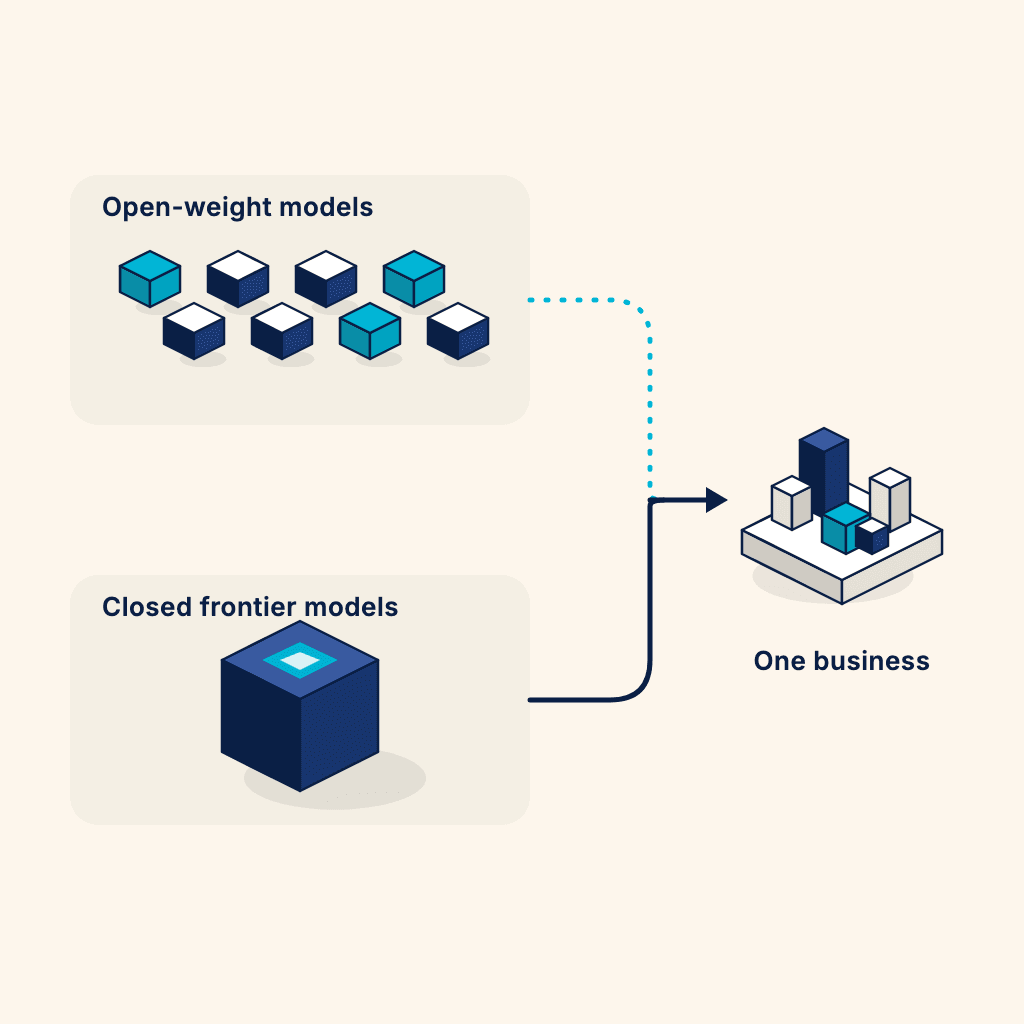
The choice between open-weight and closed AI models is being made task by task, not company by company. An open-weight model is one whose trained parameters, called weights, are published, so a company can download it, run it on its own servers and retrain it. A closed model, such as Anthropic's Claude or OpenAI's GPT, can only be used through its maker's service. Apart from NVIDIA's US-built Nemotron, every open-weight model named in this article was built by a Chinese developer or on a model from one: Alibaba's Qwen, Moonshot AI's Kimi, Z.ai's GLM and DeepSeek.
We studied 14 companies that have said publicly that they use or are testing open-weight models, among them Airbnb, Shopify, Uber, Pinterest, DoorDash and Coinbase. All 14 also use or offer closed models from Anthropic, OpenAI or Google alongside them; the list at the end of this article gives the source for each company's open-weight and closed-model use. Menlo Ventures' survey of US enterprise AI, published on 3 November 2026, shows the same split: open models carry 19% of the text processed (measured in tokens, the units of text that AI models read and write) but take 4% of spending, as at September 2026. (Menlo is an investor in Anthropic.)
Where open-weight models save money
The clearest gains come from narrow tasks that run millions of times and change slowly. Uber built the search behind Uber Eats on a model derived from Alibaba's Qwen2 and retrained on its own search logs. In Uber's randomised online test against its earlier model, searches that returned no results fell by 69%, and responses were 18% slower (Uber's research paper, March 2026; Uber Engineering, April 2026). Shopify retrained Qwen3-32B into the agent that turns a merchant's request into an automation in Shopify Flow, its workflow tool, and reports it 2.2 times faster and 68% cheaper than the frontier model, meaning one of the most capable models available, that it replaced (Shopify Engineering, 22 April 2026). Pinterest built its shopping assistant on Alibaba's Qwen3-VL and reworked it to read Pinterest's own pre-computed image data (Pinterest Engineering, 10 September 2026). Pinterest's chief executive, Bill Ready, told analysts on the third-quarter earnings call on 29 October 2026 that its open-weight models cost under 8% as much per transaction as comparable closed models.
Uber, Shopify and Pinterest did not take a model off the shelf and point it at a problem. Each changed the model to fit one job. Shopify and Pinterest report that this is where their saving comes from; Uber's sources report better results and slower responses, not a cost figure. List prices alone do not settle it. In one comparison, for prompts up to 100,000 tokens, Anthropic's Claude Haiku 5.5 costs $0.10 per million input tokens and $0.50 per million output tokens, against $0.30 and $1.20 for DeepSeek V4.1 Flash on the hosting provider Together AI. The benchmarking firm Artificial Analysis also rates Haiku higher on its intelligence index, 36 against 33, as we read it on 13 November 2026. An open-weight model becomes cheap when a company runs it at volume on servers it controls, and cheaper still once it trains the model for a narrow task. Revolut said at the AI Engineer conference in New York on 13 October 2026 that running Z.ai's GLM model on its own servers for about 2,000 engineers cut its coding-assistant bill to a tenth of what it had paid Anthropic and OpenAI. That figure is Revolut's own and unaudited, and Revolut is not one of the 14 companies.
Where closed models keep the work
Companies using open-weight models still send their hardest work to closed ones. DoorDash's AI code reviewer, which checks engineers' proposed code changes, ran on Claude when DoorDash tested alternatives on 105 past code changes, as it reported in a post on 6 July 2026. DoorDash got its best result when Moonshot's Kimi K2.6 flagged suspect code and Claude Fable 5 checked each flag: that pairing caught 65% of the real issues on DoorDash's weighted measure, against 54% for the existing Claude setup, at $3.81 a review against $3.91. With Claude Opus 4.8 as the checker, the same Kimi first pass caught 46%, fewer than the existing setup. The crypto news site Blocktempo reported on 6 July 2026 that DoorDash co-founder Andy Fang had said on X that DoorDash has the frontier model, Claude Fable, do the hardest work and delegates lower-level work to Kimi K2.6. DoorDash's blog still lists a Claude-only pair as its production reviewer, so how much of the work Kimi now does has not been made public.
In June 2026, Coinbase's chief executive, Brian Armstrong, wrote on X that Coinbase was experimenting with open-weight models as its engineers' default, and that engineers may still want a frontier model for planning (Business Insider, 29 June 2026). Lindy, which builds AI assistants, moved most of the requests from its AI agents (software that completes tasks on a user's behalf) from Claude Sonnet and Gemini to DeepSeek V4 Flash. It reports running costs on those routes down about 90% (Lindy Engineering, 24 June 2026). Sonnet still runs when a user selects it or a task needs more capability.
Stephen Watt of Red Hat told TechTarget in October 2026 that companies should start on a frontier model and move off it once its costs erode their margin. In the same article of 28 October 2026, TechTarget reported that Red Hat's pilot of Z.ai's GLM model is used by as many as 1,400 engineers, with about 70% of their requests going to open-weight models. Those engineers have a budget for frontier models and choose between the two for each job.
Some companies also want to own the model
Thomson Reuters says it spent about $40m on Thomson-1.0, a model it built by further training Alibaba's Qwen on its own legal, tax and news content (technical report, 27 August 2026). The total covers staff, computing, experts and vendors; the report puts the final training run under $450,000. Its chief technology officer, Joel Hron, compared the decision to buying a house rather than renting one (Chain of Thought podcast, 24 August 2026). Harvey, the legal AI company, has further trained Moonshot's Kimi K3 into a legal model called Tenet, still a research preview, with the stated aim of letting law firms "own their intelligence" (Harvey, 20 August 2026). Shopify says that serving open models on its own GPUs lets it decide when the model changes; its worked example is NVIDIA's US-built Nemotron (Shopify Engineering, 21 October 2026). For these firms the model is becoming part of the product. A closed model is a dependency the customer cannot inspect, and one its maker can retire.
Ownership is rarely complete or permanent. Cursor, the AI coding tool, built its Composer 2 model on Moonshot's Kimi K2.5 and confirmed the Kimi base after the model's launch in March 2026 (TechCrunch, 22 March 2026). On 18 May 2026 Cursor said it was training a significantly larger model from scratch. Hron said on the same podcast that Thomson Reuters' CoCounsel legal assistant still relies heavily on Claude models, alongside others from OpenAI and Google.
The risks lie in origin and licence terms
The Chinese origin of these models is drawing scrutiny. Committees of the US House of Representatives have written to Airbnb, to Anysphere (the maker of Cursor) and to DoorDash asking, among other things, how each company reaches Chinese models and who hosts them (Airbnb and Anysphere, 29 April 2026; DoorDash, 31 July 2026). A Department of Homeland Security order published on 20 October 2026 removes DeepSeek from federal civilian agencies, including third-party products developed using it. In September 2025, the US government's Center for AI Standards and Innovation tested DeepSeek's R1-0528, an earlier model than those named above, and found that agents built on it were on average 12 times more likely than the US frontier models it evaluated to follow malicious instructions designed to hijack them, in a simulated environment.
Running a model on a company's own servers keeps its data in-house: the weights send nothing back to their maker. It does not change what the model was trained to do. Baroness Lloyd of Effra, a UK minister, said in a written answer on 4 November 2026 that open-weight models can be hosted locally, giving organisations greater control over how data is processed, and that all AI models can present risks that need managing, including around their provenance.
Licences are tightening too. The newest Qwen and Kimi licences each set a revenue threshold. A business that sells the model as a service, and whose group revenue passes $50 million for Qwen or $20 million for Kimi over any 12 months, must sign a separate agreement with the developer before using the model for any commercial purpose. Qwen applies the same rule to businesses that sell an AI product built mainly for coding or office work. Qwen exempts a company's internal use, but only where neither the model nor its outputs are made available to anyone outside the company.
Siemens said in June 2026 that it uses DeepSeek and Qwen, and NVIDIA's Nemotron, alongside other US and European models. Cedrik Neike, chief executive of Siemens' Digital Industries business, told Reuters that sovereignty is often confused with self-sufficiency, and that self-sufficiency is not the way to achieve it (Reuters, 22 June 2026; full text).
What this means for a UK business
QuantSpark is model-agnostic, so our advice follows what these companies did rather than what any vendor sells. Start on closed models while you find out what works; a four-week prototype costs far less than a platform decision. Build a test set from your own work before switching anything: DoorDash, Shopify and Cursor each chose models by testing them on their own tasks. Move a task to an open-weight model when it is narrow, high in volume, stable and backed by data you can train on, and keep closed models for planning, judgement and anything you cannot test thoroughly. Read the licence, and decide where the weights will run before you decide which weights to use.
The House committees asked Airbnb to identify each Chinese model it deploys, tests or is evaluating, and whether it is reached through an API, run on Airbnb's own infrastructure or served by a third-party provider. Every board should be able to say the same about each model its company uses.
The 14 companies and our sources
We looked for companies that have said publicly that they use or are testing open-weight models, and read each one's own announcements, engineering posts and press reports between 6 and 13 November 2026. The list is the companies we found, not a sample of all businesses. For Cursor, Perplexity and 8090, "uses closed models" includes offering them in their own products.
- Airbnb. Open-weight: Chief executive Brian Chesky said in October 2025 that Qwen runs inside its customer service agent (Silicon UK, 23 October 2025; CNBC, 22 October 2025). Closed: OpenAI models in guest and host support (Airbnb Newsroom, 23 September 2026).
- Shopify. Open-weight: Qwen3-32B in the Flow agent (Shopify Engineering, 22 April 2026). Closed: Sidekick, its AI assistant, runs on a frontier model (Shopify Engineering, 21 October 2026); The New Stack reported on 7 August 2026 that Shopify still pays Anthropic.
- Uber. Open-weight: Qwen2-based search model (arXiv, 11 March 2026). Closed: Anthropic's Claude Code in its software-engineering tooling, with caching settings tuned for Anthropic and OpenAI models (Uber Engineering, 27 August 2026).
- Pinterest. Open-weight: Qwen3-VL in its shopping assistant (Pinterest Engineering, 10 September 2026). Closed: OpenAI for some features and coding (Fortune, 17 March 2026).
- DoorDash. Open-weight: tested Kimi K2.6 as the first-pass reviewer (DoorDash Engineering, 6 July 2026); Blocktempo reported on 6 July 2026 that co-founder Andy Fang said on X that DoorDash delegates lower-level work to Kimi K2.6. Closed: Claude, in the same post.
- Coinbase. Open-weight: Armstrong's post on X, 26 June 2026. Closed: frontier models for planning, in the same post; The New Stack reported on 7 August 2026 that Coinbase still pays Anthropic.
- Red Hat. Open-weight: Z.ai's GLM pilot (TechTarget, 28 October 2026). Closed: Google Gemini across the organisation and Claude Code for engineers (Red Hat blog, 19 November 2025).
- Thomson Reuters. Open-weight: Thomson-1.0, built on Qwen (technical report, 27 August 2026). Closed: Claude, OpenAI and Google models in CoCounsel, per Hron (podcast, 24 August 2026).
- Harvey. Open-weight: Tenet, built on Kimi K3 (Harvey, 20 August 2026). Closed: OpenAI, Anthropic and Google models in production (Harvey release notes, 14 and 28 October 2026).
- Cursor. Open-weight: Composer 2 on Kimi K2.5 (Cursor technical report, 27 March 2026). Closed: OpenAI, Anthropic and Google models offered in the product (Cursor docs, read 6 November 2026).
- Lindy. Open-weight: DeepSeek V4 Flash (Lindy Engineering, 24 June 2026). Closed: Claude Sonnet still runs, in the same post.
- Siemens. Open-weight: DeepSeek and Qwen (Reuters via ETEnterpriseAI, 23 June 2026). Closed: Google's models, in a Google Cloud case study of 16 June 2026.
- Perplexity. Open-weight: R1 1776, its retrained version of DeepSeek-R1 (model card, February 2025), and Kimi K3 and GLM in Search (Perplexity help centre, 27 October 2026). Closed: OpenAI, Google and Anthropic models offered in Search (Perplexity help centre, 27 October 2026).
- 8090. Open-weight: Chamath Palihapitiya said in October 2025 that 8090 runs Kimi K2 (All-In podcast transcript, 3 October 2025). Closed: its coding tools run on Anthropic (Business Insider, 7 March 2026), and its Software Factory product offers Claude, GPT and Gemini.
CEO, QuantSpark
Adam founded QuantSpark in 2016 to bridge the gap between strategy consulting and engineering. He has worked across financial services, retail and the public sector, and previously led data and analytics work for FTSE 100 organisations.