
A cloud data lakehouse for an online vehicle-trading platform
A cloud-based data lakehouse consolidated siloed sources into a single relational store, enabling business intelligence and analytics across a fast-growing vehicle-trading platform.
- A few weeks
- Engagement length
to a working, demonstrable data lakehouse
Weeks
- Analysis is now possible across previously siloed datasets, independent of their original platform or format
- Business users can interrogate the centralised data through self-service business-intelligence tools with minimal technical training
- A scalable, low-maintenance design keeps operational overheads low as the platform continues to grow
The problem
A fast-growing online vehicle-trading marketplace captured data right across the business, but the data itself was fragmented rather than absent. It lived in relational databases, NoSQL stores and spreadsheets, each with its own format and access pattern, with no common layer connecting them.
This fragmentation mattered because the platform's ambitions for business intelligence and advanced analytics both depend on relational, queryable data, and the underlying estate was not built that way. Every team could see its own slice of the business through its own system; nobody could easily see the whole of it, and questions that crossed system boundaries were harder to answer than questions that stayed within a single system.
Left unaddressed, the gap between what the business wanted to ask of its data and what the fragmented estate could answer would only have widened as the platform continued to grow, with business users dependent on technical teams for even routine analysis.
How we delivered it
Audit and map the data estate
Catalogue every source system and its format, relational databases, NoSQL stores and spreadsheets alike, to establish the true scope of fragmentation before choosing an architecture.
Design a cloud lakehouse architecture
Select a scalable cloud-based lakehouse pattern able to ingest structured, semi-structured and unstructured data, rather than forcing a rigid warehouse-only model onto sources that did not start out relational.
Build integration pipelines
Construct the extract-transform-load processes that pull data from every relational, NoSQL and spreadsheet source into a common ingestion layer.
Centralise into a single relational store
Land the integrated data into one relational cloud data warehouse, giving every downstream analysis a single, consistent structure to query against.
Enable self-service business intelligence
Connect business-intelligence tools directly to the centralised warehouse so business users can query and explore data themselves, with minimal technical training required.
Prioritise a working product over a long specification phase
Favour rapid delivery of a demonstrable, functioning version within weeks, validating design choices against real use rather than extended upfront design.
Map the sources
Catalogue relational, NoSQL and spreadsheet data across the business
Design the lakehouse
Choose a scalable, low-maintenance cloud architecture
Integrate the data
Build pipelines pulling every source into one ingestion layer
Centralise
Land data in a single relational cloud data warehouse
Enable self-service
Connect BI tools so business users query directly
From fragmented source systems to self-service analytics, in one cloud lakehouse build
Built with
Cloud data platform
Hosts the lakehouse architecture and scales as the platform's data volumes grow
Data lakehouse
Ingests structured, semi-structured and unstructured sources ahead of central analysis
Relational cloud data warehouse
Provides the single queryable structure that downstream analysis and BI tools read from
Self-service business-intelligence tooling
Lets business users interrogate centralised data directly, with minimal technical training
Source systems (relational databases, NoSQL stores, spreadsheets)
Original siloed data holdings integrated into the lakehouse
Return on investment
Method, not a banked figureWeeks
to a working, demonstrable data lakehouse
What was delivered
- Analysis is now possible across previously siloed datasets, independent of their original platform or format
- Business users can interrogate the centralised data through self-service business-intelligence tools with minimal technical training
- A scalable, low-maintenance design keeps operational overheads low as the platform continues to grow
How a return would be measured
The source material reports no quantified financial return, so none is stated here. Generically, an engagement of this shape is usually justified by comparing two costs: the ongoing cost of specialist engineering time spent reconciling siloed data and hand-building reports before the build, against the marginal cost of business users self-serving BI queries once data is centralised afterwards, plus the avoided cost of scaling a fragmented multi-system estate rather than one warehouse as the business grows. That is a description of the calculation method only; no specific pound figures, percentages or time-saving estimates exist in the source and none should be inferred.
A cloud data lakehouse for an online vehicle-trading platform
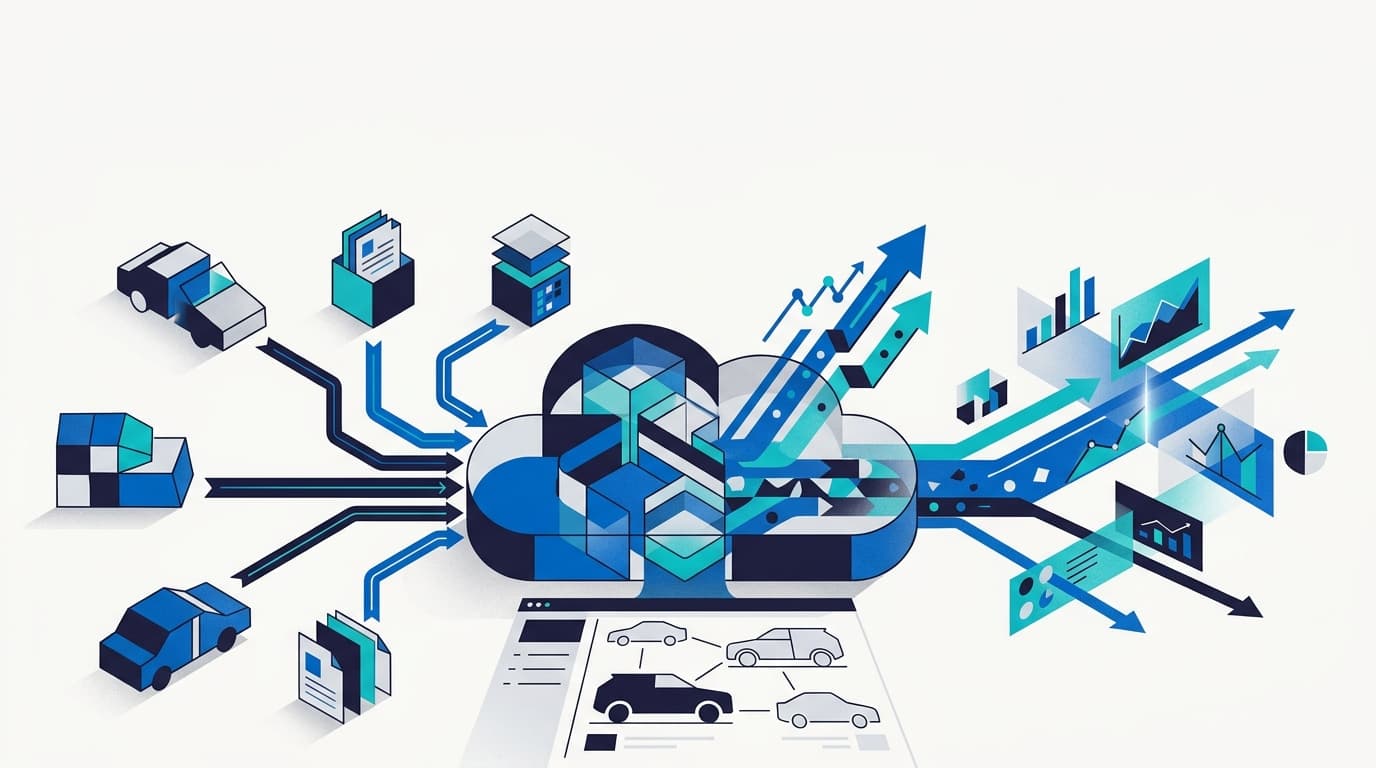
A fast-growing online vehicle-trading marketplace now runs business intelligence and analytics across data that was previously locked apart, and it reached that point with a working, demonstrable product built within weeks. That speed matters: the design was deliberately future-proof and low-maintenance, a fit with the platform's own fast-moving development culture.
The problem was fragmentation, not absence, of data. The platform captured information right across the business, but that information lived in relational databases, NoSQL stores and spreadsheets, each with its own format and access pattern, none of them connected to the others. Every team could see its own slice of the business through its own system. Nobody could easily see the whole of it. That mattered because the platform's ambitions for business intelligence and advanced analytics both depend on relational, queryable data, and the underlying estate was not built that way. Questions that crossed system boundaries were harder to answer than questions that stayed within a single system, and left unaddressed that gap between what the business wanted to ask of its data and what the fragmented estate could answer would only have widened as the platform continued to grow.
QuantSpark's response was to design and build a cloud-based data lakehouse: an architecture able to take in structured, semi-structured and unstructured data from disparate sources and resolve it into a single relational store, rather than forcing a rigid warehouse-only model onto data that never started out relational. The build ran as a staged workflow. It began with an audit that mapped every source system and its format, so the true scope of the fragmentation was understood before any architecture was chosen. From there, the lakehouse pattern itself was selected specifically for its ability to scale on cloud infrastructure without heavy ongoing maintenance, a deliberate fit with a company that moves fast and does not want a data platform that becomes its own maintenance burden. Integration pipelines were then built to pull every relational, NoSQL and spreadsheet source into a common ingestion layer, which fed the centralisation step proper: landing all of that integrated data into one relational cloud data warehouse, giving every downstream analysis a single, consistent structure to query against. The final step connected self-service business-intelligence tools directly to that warehouse, so business users could explore data themselves with minimal technical training, rather than routing every question through engineering. Throughout, the team prioritised getting a working version in front of the business within weeks over running an extended specification phase, testing design choices against real use early rather than late.
The systems that underpin this are best described categorically, since the source does not name specific vendors: a cloud data platform hosting the lakehouse, the lakehouse layer itself unifying the disparate inputs, a relational cloud data warehouse as the single queryable store, and self-service BI tooling sitting on top for business users. The original siloed systems, relational databases, NoSQL stores and spreadsheets, remain the source systems feeding in, just no longer the endpoint for analysis.
The value delivered is qualitative but concrete. Analysis is now possible across datasets that were previously siloed by system and format. Business users can query the centralised data directly through self-service BI, without needing deep technical skills to do so. And because the architecture was designed to be low-maintenance and cloud-scalable from the outset, operational overheads stay manageable as the platform continues to grow, rather than compounding alongside it. No specific financial return is quantified in the available material, so none is claimed here; the honest way to describe the return on an engagement like this is by the shape of the saving, less specialist engineering time spent reconciling data and building bespoke reports, more direct self-service query time for the business, and a lower marginal cost of scaling one warehouse compared with an ever-multiplying set of disconnected systems, rather than by a specific number.
Figures are drawn from completed QuantSpark engagements. Clients are anonymised by agreement; on a call we will walk you through how each number was measured and, where the client has agreed, put you in touch with a reference.
This engagement used our Data platform builds practice
Related case studies
A private equity owned B2B SaaS group
Validating a private equity buy-and-build strategy with recurring-revenue analytics
A B2B switching service for energy, telecoms and insurance
Data engineering diagnostic and roadmap for a B2B switching service
A global ESG-focused asset manager
Automating a global asset manager's data pipeline to streamline decisions
Related insights
How AI Coding Assistants are Transforming Software Development: Power, Potential, and Best Practices
AI coding assistants like GitHub Copilot are reshaping software development, enabling faster prototyping and creative problem-solving. While powerful, thoughtful deployment with clear best practices…

The Brunelleschi Lesson: Why Operational AI Demands Both Human Ingenuity and Structural Rigour
Successfully implementing enterprise AI requires a dual focus: engaged human ingenuity and robust data infrastructure. Neglecting either side leads to underperformance, a lesson discernible from historical breakthroughs in art and science.

QuantSpark: Turning AI Ambition into Operational Reality for Private Equity
QuantSpark partners with private equity firms and their portfolio companies to deliver end-to-end AI transformation, combining strategy, AI, and software engineering to build high-ROI applications
Ask about our work
Answers only from our documented case studies
Powered by the same applied-AI approach we deliver for clients
Solving something similar in SaaS & Tech?
Get in touch. We will discuss your challenge and show you what is possible.
Read more on AI for SaaS and technology