
The Separation Event: Augmented Firms vs. Exposed Firms
The corporate world is splitting in real time. One group is building with machine leverage inside the operating system. The other is still paying full price for human bottlenecks. This white paper asks what that means, and what can be done.
Waiting is never neutral
Every quarter spent operating without embedded AI workflows is a quarter in which the compounding loop runs for your competitors. McKinsey calls this productivity debt: unrealised efficiency gains that accumulate over time and become progressively more expensive to close.
The gap becomes structural, then permanent
Once a cognition gap starts compounding it stops behaving like a normal productivity upgrade. Leading firms use the advantage to attract the best talent, price more competitively and invest in the next capability layer. By the time trailing firms recognise it, the conditions that created it are already self-sustaining.
The value is in the workflow, not the tool
McKinsey's analysis of 25 organisational attributes found workflow redesign has the single largest effect on EBIT impact from generative AI, larger than model selection, tooling or budget. Firms reporting significant returns are twice as likely to have redesigned end-to-end workflows before selecting tools.
The policy window is open now
The UK Government has made a funded bet on AI and is actively seeking first customers for credible implementation. Organisations that arrive with a proven, evidence-based operations model enter a receptive environment. That window will not stay open, and early movers will set the standard everyone else is measured against.
Executive summary: the case in 60 seconds
We are living through a separation event. Not a productivity upgrade and not a technology cycle, but a structural divergence in the capacity of organisations to think, move and compete. It is already visible in the revenue data.
AI is splitting the corporate world into augmented firms and exposed firms. One side is learning how to operate with an extra cognition layer. The other side is slowly discovering that waiting was never neutral. This does not end with everyone getting a little more efficient.
This white paper draws on a wide range of evidence: real-world revenue data across more than 50,000 businesses, productivity research from Harvard, MIT and BCG, and the UK Government's own industrial strategy. The aim is to build a rigorous, evidence-led case for closing the execution gap, and why it matters now.
The audience is simple: every CEO, CFO, Board member and policymaker who has discussed AI strategy without yet embedding AI operations.
It ends with a lot of companies realising too late what they were competing against.
I. The signal: the compounding gap
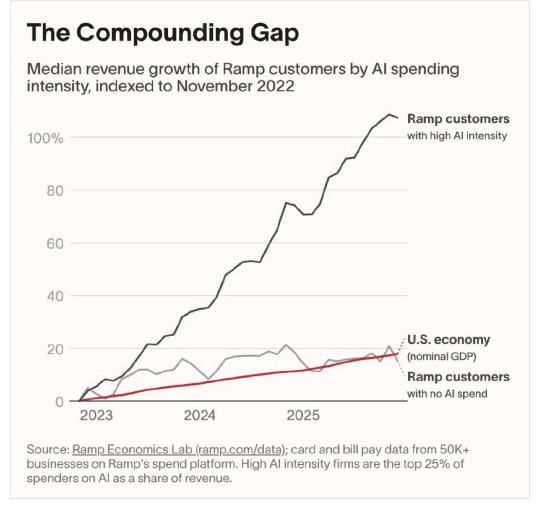
In late 2025, Ramp Economics Lab published what may be the most commercially significant chart of the decade: median revenue growth across more than 50,000 businesses, split by how heavily each firm was spending on AI.
The real signal is that a cognition gap is opening between firms. Once that starts compounding it stops behaving like a normal productivity upgrade. It becomes a separation event.
As external analysis of the Ramp dataset put it, the firms increasing AI spend are not simply buying software. They are replacing drag, redesigning workflows, management habits and decision structures around a new operating model. The revenue line then feeds back into more AI spend, more talent and faster iteration. Once that loop closes, the laggard does not merely fall behind. It falls into a different era.
This framing deserves to sit at the top of every board agenda in the UK. It is not hyperbole. It is both precisely what the data shows and what the peer-reviewed academic literature independently confirms from a different direction.
One group is building with machine leverage inside the operating system. The other group is still paying full price for human bottlenecks.
II. What does this mean? Five systemic implications
The Ramp data and the academic research together describe not a productivity story but a structural shift in competitive architecture. Five implications stand out as strategically critical.
2.1 The loop is self-reinforcing. High AI spend generates faster revenue. Faster revenue funds more AI spend, more talent and more experimentation, which in turn generates faster analysis, faster iteration and faster decisions. Once the loop starts closing, the laggard does not merely fall behind. Time makes the gap wider, not narrower. This is not a gap that patience closes.
2.2 Waiting has a measurable cost. Every quarter a firm operates without embedded AI workflows is a quarter in which the compounding loop is running for competitors. McKinsey's 2025 analysis identifies this as productivity debt: unrealised efficiency gains that accumulate over time. When marketing teams use AI while finance continues with manual processes, the organisation is not merely less efficient. It is accruing a deficit that becomes progressively more expensive to close.
2.3 The selection effect sharpens the implication. Yes, stronger, more ambitious, more tech-forward firms were likely to be early AI buyers. But this does not soften the implication, it sharpens it. A force multiplier landed in the hands of the already capable. The best firms got stronger first, and the gap itself became a weapon. Structural competitive moats form not through one superior decision, but through an accumulating series of slightly faster ones.
2.4 Organisational metabolism, not tool acquisition. The firms winning on AI are not distinguished by which platform they purchased. They are distinguished by their willingness to redesign workflows, management habits and decision structures. BCG's 2025 research confirms it: organisations that redesign end-to-end workflows are twice as likely to report significant financial returns from AI. Workflow redesign, not model selection, is the differentiator.
2.5 The performance gap becomes permanent. What begins as a performance gap becomes a structural one. Leading firms use their AI-generated advantage to attract the best talent, offer faster and better client service, price more competitively and invest more heavily in the next capability layer. By the time trailing firms recognise the gap, the structural conditions that created it are already self-sustaining. This is not a temporary disadvantage. It is a new equilibrium.
They are not just buying tools. They are replacing drag.
III. The research evidence base
The Ramp data tracks outcomes at the firm level. The academic literature explains the mechanism, and quantifies it in controlled conditions. These findings are not projections, they are measured results.
The productivity effect is large and consistent. The Harvard Business School / BCG field experiment, covering 758 consultants across 18 realistic consulting tasks, established a clear productivity baseline for AI-augmented knowledge work. Professionals with AI access completed tasks faster, in greater volume and at substantially higher quality.
The jagged frontier: where AI helps and where it doesn't. The Harvard team introduced the concept of the jagged technological frontier. AI assistance dramatically improves performance in certain task categories and actively degrades it in others, even within the same knowledge workflow and at seemingly similar levels of difficulty. Knowing which side of the frontier a task sits on is a core organisational competency that most firms have not yet developed. This is a fundamental reason generic AI deployment underperforms: tools are applied indiscriminately rather than surgically.
The adoption paradox: wide but shallow. McKinsey's 2025 global survey found 88% of large organisations using AI in at least one function. Yet EY's 2025 Work Reimagined Survey of 15,000 employees found only 5% using AI in advanced, transformative ways. BCG's research is starker: only 5% of companies are achieving AI value at scale, 60% report minimal gains despite substantial investment, and 74% of investing companies are showing no tangible return. The gap between deployment and transformation is not a technology problem. It is an execution problem.
I do not think enough people are considering what it means when a technology raises all workers to the top tiers of performance.
The workflow redesign finding and the leadership blind spot
Workflow redesign has the single largest effect on EBIT impact from generative AI. McKinsey's 2025 analysis of 25 organisational attributes found it larger than model selection, tooling or budget. Organisations reporting significant financial returns are twice as likely to have redesigned end-to-end workflows before selecting tools. Most organisations do the exact opposite.
Strategy is being made by the people with the least direct experience of the technology. McKinsey's 2025 workplace data surfaced a critical disconnect: leadership estimates only 4% of employees use generative AI for at least 30% of their daily work. The actual figure, from employee self-reporting, is 13%, more than three times higher. In the UK specifically, 48% of senior leaders have never used an AI tool themselves, versus 29% of middle managers. This is a governance failure that compounds the execution gap.
The wider research points the same way. BCG's future-built firms deliver 3.6 times higher total shareholder return, which makes AI execution a capital markets event, not just an operations one. Some 90% of high-value vertical AI use cases remain in pilot mode, so the transformative value is locked in experimentation, not operations. And 78% of AI users bring their own tools without approval, with shadow AI usage growing 250% year-on-year in some sectors: the exposure is material, and it is accelerating.
IV. The questions boards must now ask
Strategic leadership is not about having answers to AI, it is about asking the right questions at the right altitude. These are the eight highest-order questions that C-suites and boards should be wrestling with today.
- Where on the Ramp curve are we, and which direction are we heading? The Ramp data is directional, not just descriptive. If you cannot answer this with data, you are already at a strategic disadvantage relative to those who can.
- What is the cost of our current productivity debt, and who is accruing the benefit? Every quarter without embedded AI workflows is a quarter in which the compounding loop is running for your competitors. Have you modelled the cumulative cost of delay?
- What proportion of our leadership team has direct, hands-on experience using AI tools? With 48% of UK senior leaders having never used an AI tool, strategy is being made from abstraction. Can your board credibly evaluate an AI roadmap it has never experienced?
- Have we mapped our workflows against the jagged frontier? AI makes some tasks dramatically better and actively degrades others. Has your organisation identified which side of the frontier each of its core workflows sits on?
- Is our AI strategy driven by tool procurement or workflow redesign? The single largest predictor of EBIT impact from AI is workflow redesign before tool selection. Are you buying platforms, or restructuring how work gets done?
- What is our exposure to shadow AI, and is it growing? Shadow AI usage is growing 250% year-on-year in some sectors. What data, including client files, financial models and legal documents, is leaving your governance perimeter through unsanctioned tools?
- What is our theory of competitive advantage in a world where AI raises all floors? If AI equalises baseline performance across the industry, where does your differentiation come from? Domain expertise and speed to outcome need to be articulated and operationalised before competitors do it first.
- Is our training investment proportionate to our licence investment? EY found employees with 81+ hours of AI training gain 14 hours of productivity per week. The median employee gets 8 hours of training. The difference between using AI and using AI well is enormous, and it comes down to training, not technology.
Why it matters
The policy window is open now
The UK Government has made a funded bet on AI and is actively seeking first customers for credible implementation. Organisations that arrive with a proven, evidence-based operations model enter a receptive environment. That window will not stay open, and early movers will set the standard everyone else is measured against.
Talk to us about closing your execution gapV. The UK imperative: government and policy context
The UK Government has made an explicit, funded bet on AI as the centrepiece of economic renewal. The policy environment has never been more aligned with commercial ambition, or more demanding of operational proof.
The political commitment. In January 2025, the Prime Minister committed to all 50 recommendations of the Clifford AI Opportunities Action Plan. The IMF estimates that fully embracing AI could boost UK productivity by 1.5 percentage points annually, an uplift worth up to £47 billion to the economy every year over a decade. By January 2026, the Government's one-year progress report confirmed the Modern Industrial Strategy had launched, with £150 million for AI programmes including dedicated support for professional and business services. UKRI has committed a record £1.6 billion directly to AI over the next four years.
The adoption disparity in British business. Despite this policy energy, McKinsey's UK analysis reveals a paradox: widespread usage but unrealised gains. The Government's own DSIT evidence review, published January 2026, found that 52% of working-age adults cannot perform all twenty tasks in the Essential Digital Skills framework, including 48% of younger workers and 20% of tech sector employees. The disparity in AI skills is not confined to the boardroom.
The policy window. For the first time, the UK Government is actively seeking to act as a first customer for credible AI implementation partners. Regional AI Adoption Hubs are launching in 2026, and the professional and business services AI programme is funded and seeking delivery partners. The UK Industrial Strategy explicitly commits to additional help for professional and business services to adopt AI most effectively: law firms, PE funds, consultancies and accounting practices are in the policy spotlight. Organisations that arrive with a proven, evidence-based AI operations model are entering a receptive environment. That window will not remain open indefinitely, and early movers will shape the standards everyone else is measured against. The question is not whether this sector will be transformed. It is who leads that transformation.
VI. The execution problem
The data is unambiguous. The policy intent is clear. The technology is available. So why are 95% of organisations failing to achieve AI value at scale? The answer is consistent across every source: it is an execution problem, not a technology problem.
Why generic AI fails in professional services. The challenge is most acute in knowledge-intensive firms: professional services, legal, private equity, consulting and finance. These organisations have four specific characteristics that make generic AI deployment fail:
- Domain specificity. The value is in the firm's own criteria, formats and decision logic.
- Data complexity. Inputs arrive in every format: PDFs, Excel models, emails, legal documents.
- Governance requirements. Regulated environments require audit trails and data sovereignty.
- Adoption inertia. Senior professionals are sceptical, time-poor, and will not adopt tools that disrupt established workflows.
Microsoft Copilot and generic AI platforms handle none of these requirements adequately. Closing the gap requires something more deliberate: deep workflow analysis before any tool is selected; integration with the firm's own data, formats and decision criteria; governance architecture that satisfies regulatory and client obligations; and a change management process that meets professionals where they are rather than asking them to adapt to the tool. The chasm between having AI tools and AI having transformed how a firm operates is bridged not by better software, but by better implementation. Implementation is precisely what most AI deployments skip.
VII. A framework for action
Based on the research base and QuantSpark's decade of operational experience inside knowledge-intensive firms, six phases define the path from exposure to augmentation.
Phase 01: Diagnose before you deploy. Map your workflows against the jagged frontier. Identify two or three use cases with the highest value-to-complexity ratio. The BCG data is clear: focus wins over breadth, and the most successful firms pursue half as many opportunities at twice the ROI.
Phase 02: Redesign, don't layer. McKinsey's most important finding is to redesign workflows before selecting tools. AI layered onto legacy processes produces legacy-speed results. A workflow is only as fast as its slowest step, and AI cannot fix a process that was never designed to move. The process must change first. This is the differentiator between 1x and 3.6x returns.
Phase 03: Build sovereign, not shadow. Deploy inside your own Microsoft Tenant: Entra ID, Purview, access controls, audit trails. Stop shadow AI by providing a sanctioned alternative that is faster, more capable, and that protects client data.
Phase 04: Prototype in weeks, not quarters. The compounding loop starts closing the moment working AI hits real workflows. A prototype in two weeks is achievable and is the proof point that drives organisational commitment. Planning marathons do not start the loop.
Phase 05: Train proportionately. The difference between 8 and 81 hours of AI training is 6 hours of productivity per person per week. Training investment must match licence investment. Without it, adoption fails and the loop never closes.
Phase 06: Measure and compound. Define metrics before you start: time saved per workflow, senior hours redirected, error rates, revenue per head. The firms on the right side of the Ramp curve measure obsessively. The metrics create the feedback loop that drives reinvestment.
Conclusion: the window is open. The question is execution.
The Ramp chart is not a forecast. It is a record of what has already happened across 50,000 businesses, over three years, in real revenue terms. The line that pulls away from the pack does not do so because of superior technology. It does so because of superior metabolism: the willingness to redesign workflows, management habits and decision structures around AI, and the execution capability to do it fast enough for the compounding to take hold.
The peer-reviewed evidence from Harvard, MIT, BCG, McKinsey and EY confirms the mechanism at the level of individual tasks and individual firms. The UK Government's policy framework confirms the national stakes. The Ramp data confirms the outcome.
What remains is execution. Execution is where most organisations are failing. Not through lack of ambition, but through lack of domain-specific implementation capability, workflow redesign expertise, and the change management discipline to make AI stick in complex professional environments.
The firms that close the execution gap in the next 12 to 18 months will not simply be more efficient. They will have built a different kind of organisation, one with AI embedded in its operational DNA that is generating compounding returns and structurally difficult to match by those who start later.
The separation event is not coming. It is already underway, and the firms that act now are the ones writing the other half of the chart.
Prefer to read offline?