
Why Pharma Organisations Need Systems Thinking to Scale AI
AI in pharma and CROs is failing because organisations treat it as a tool to deploy rather than a system to redesign. This paper explains why, what it costs, and how leaders move from pilot success to portfolio-level economic impact within 12 to 18 months.
Pilots succeed while portfolio value stalls
Across life sciences, AI is deployed into isolated functions, layered onto existing workflows and measured locally. The predictable result is a run of successful pilots that never scales, and a return on investment the board cannot see. The gap is not capability. It is the level at which AI is being applied.
The cost of the wrong approach is measurable
42% of current pharma AI initiatives fail to meet ROI expectations, almost always for non-technical reasons. With median-to-mean R&D cost running at $708m to $1.31bn per approved drug, even a 10% improvement in trial design or cycle time is worth tens of millions per programme. The economic gap between optimising and transforming is quantifiable.
Technology is no longer the limiting factor
AI capability is advancing and investment is rising, but enterprise outcomes are not following. McKinsey estimates 75-85% of pharma workflows can be enhanced or automated by AI agents. The differentiator is no longer the tool. It is how the organisation is structured to extract value from it.
Redesign the system, not the task
The organisations that achieve material impact treat AI as a system intervention: they redesign information flows, decision rights, incentives and workflows across the enterprise, and measure impact at the level of the asset, the trial and the portfolio. Book a 90-minute Systems Diagnostic to map where your organisation sits and the three highest-leverage interventions in your operating model.
Executive summary: the case in 60 seconds
AI in pharma and CROs is failing because organisations treat it as a tool to deploy rather than a system to redesign, and the financial cost of that choice is measurable.
The economic gap. Across life sciences, AI is deployed into isolated functions, layered onto existing workflows and measured locally. The outcome is predictable: pilots succeed, value does not scale, and return on investment remains unclear to the board. McKinsey's 2025 analysis estimates that 75-85% of pharma workflows can be enhanced or automated by AI agents, yet 42% of current AI initiatives in the sector fail to meet ROI expectations.
The thesis. Organisations that achieve material impact take a different approach. They treat AI as a system intervention, not a tool deployment. They redesign information flows, decision rights, incentives and workflows across the enterprise, measuring impact at the level of the asset, the trial and the portfolio, not the pilot.
This paper draws on systems-biology analogies, peer-reviewed research from McKinsey, Nature Medicine, the FDA CTTI and JAMA Network Open, and Donella Meadows' leverage-points framework, alongside QuantSpark's operational experience inside pharmaceutical and CRO organisations. It sets out a practical, systems-led approach to identifying and scaling high-value AI opportunities, with the commercial detail required for board-level decisions.
Who this is for. Every CEO, CFO, Chief Medical Officer, Head of Clinical Operations, Chief Digital Officer and board member in pharma, biotech and clinical research who has discussed AI strategy without yet redesigning the system around it.
Pilots succeed, value does not scale, and return on investment remains unclear to the board.
I. The AI illusion: investment without impact
Pharma is not struggling to adopt AI. It is struggling to extract value from it. The pharma AI market is forecast to grow from roughly $4bn in 2025 to $25.7bn by 2030 (McKinsey, 2025). Yet only 40-50% of the top 20 pharma firms that have invested heavily in modernised clinical IT can yet point to a clear return.
The pattern is consistent:
- AI capability is advancing.
- Investment is increasing.
- Enterprise outcomes are not following.
This is not a technology failure. AI is simply being applied at the wrong level of the system.
This is not a technology failure; AI is simply being applied at the wrong level of the system.
II. Organisations behave like biological systems
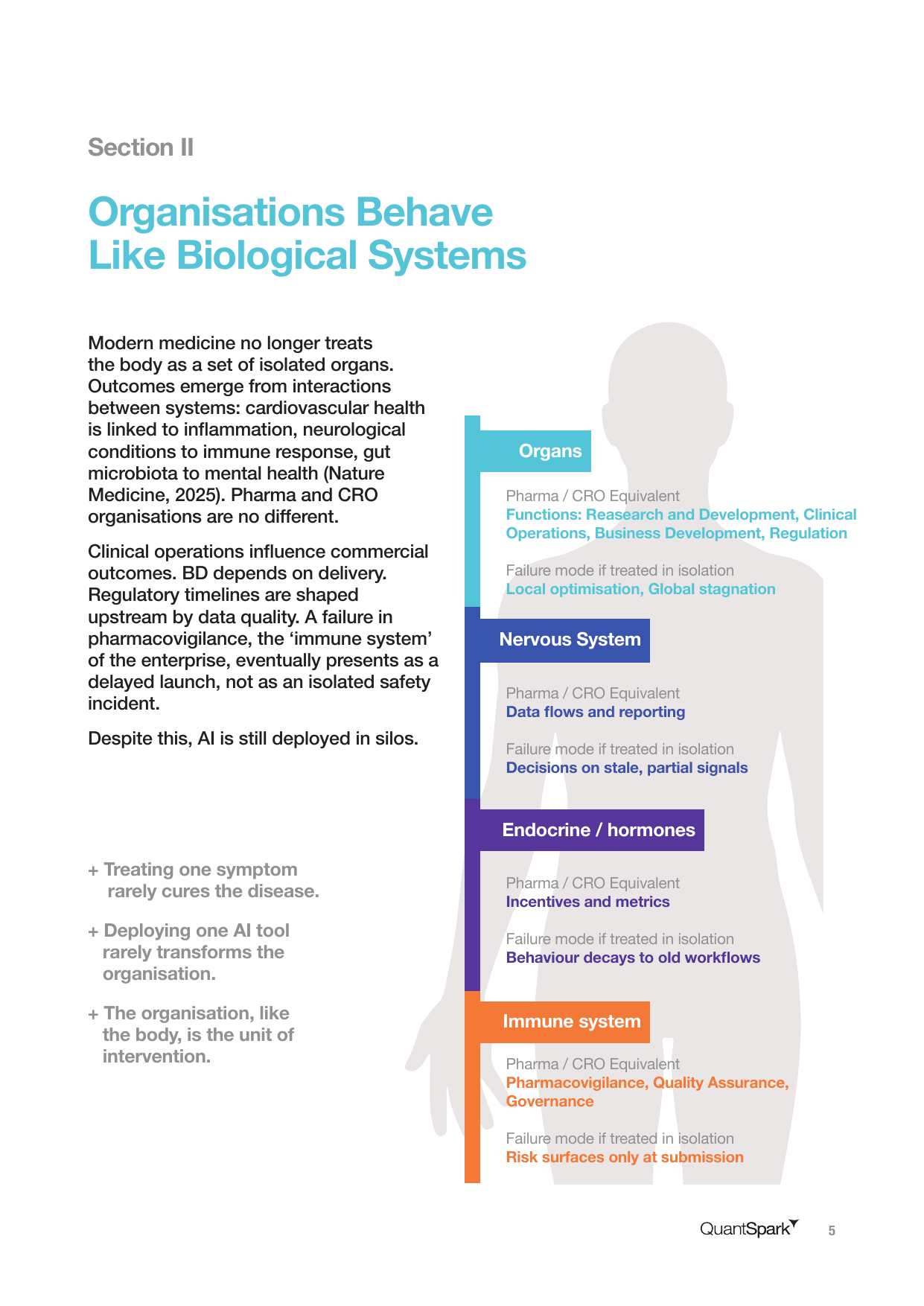
Modern medicine no longer treats the body as a set of isolated organs. Outcomes emerge from interactions between systems: cardiovascular health is linked to inflammation, neurological conditions to immune response, gut microbiota to mental health (Nature Medicine, 2025). Pharma and CRO organisations are no different.
Clinical operations influence commercial outcomes. Business development depends on delivery. Regulatory timelines are shaped upstream by data quality. A failure in pharmacovigilance, the 'immune system' of the enterprise, eventually presents as a delayed launch, not as an isolated safety incident.
Despite this, AI is still deployed in silos.
- Treating one symptom rarely cures the disease.
- Deploying one AI tool rarely transforms the organisation.
- The organisation, like the body, is the unit of intervention.
The organisation, like the body, is the unit of intervention.
III. The mistake: linear thinking in a nonlinear system
The dominant approach to AI adoption is linear: identify a problem, select a tool, implement it, measure output. This works in stable, bounded environments. Clinical development is none of those things.
Consider clinical trial recruitment delays, the single largest driver of trial cost overrun. 86% of trials miss their enrolment timelines (industry benchmark, 2025).
A linear response focuses on immediate causes such as site activation or investigator engagement. A systems view considers the full network of drivers: data latency across sites, protocol design complexity, patient identification pathways, sponsor and CRO incentives, and regulatory constraints (FDA / CTTI Workshop, 2025). The intervention points, and therefore the outcomes, are fundamentally different.
- AI does not create value at the point of deployment.
- Value compounds as workflows, decisions and data align around it.
86% of trials miss their enrolment timelines.
IV. Where value actually sits: leverage points
The same technology can generate incremental gains or system-level transformation. The difference is where it is applied.
Low-leverage AI investment automates reports, accelerates isolated workflows and reduces manual effort within existing processes. It generates incremental improvements. It does not change system outcomes, or board-level metrics.
High-leverage AI investment redesigns information flows, changes decision-making rules, aligns incentives across functions and redefines goals and operating models (Meadows, 1999; McKinsey, 2025). The technology is often the same. The impact is not.
The cost of standing still. Clinical development economics make the case for high-leverage intervention on their own terms. Median-to-mean R&D cost runs at $708m to $1.31bn per approved drug (JAMA, 2025). Around 90% of trial candidates fail, at a per-patient cost of $113k to $136k. Against that backdrop, a 10% improvement in trial design or cycle time is worth tens of millions per programme.
The technology is often the same. The impact is not.
V. A systems approach to identifying AI opportunities
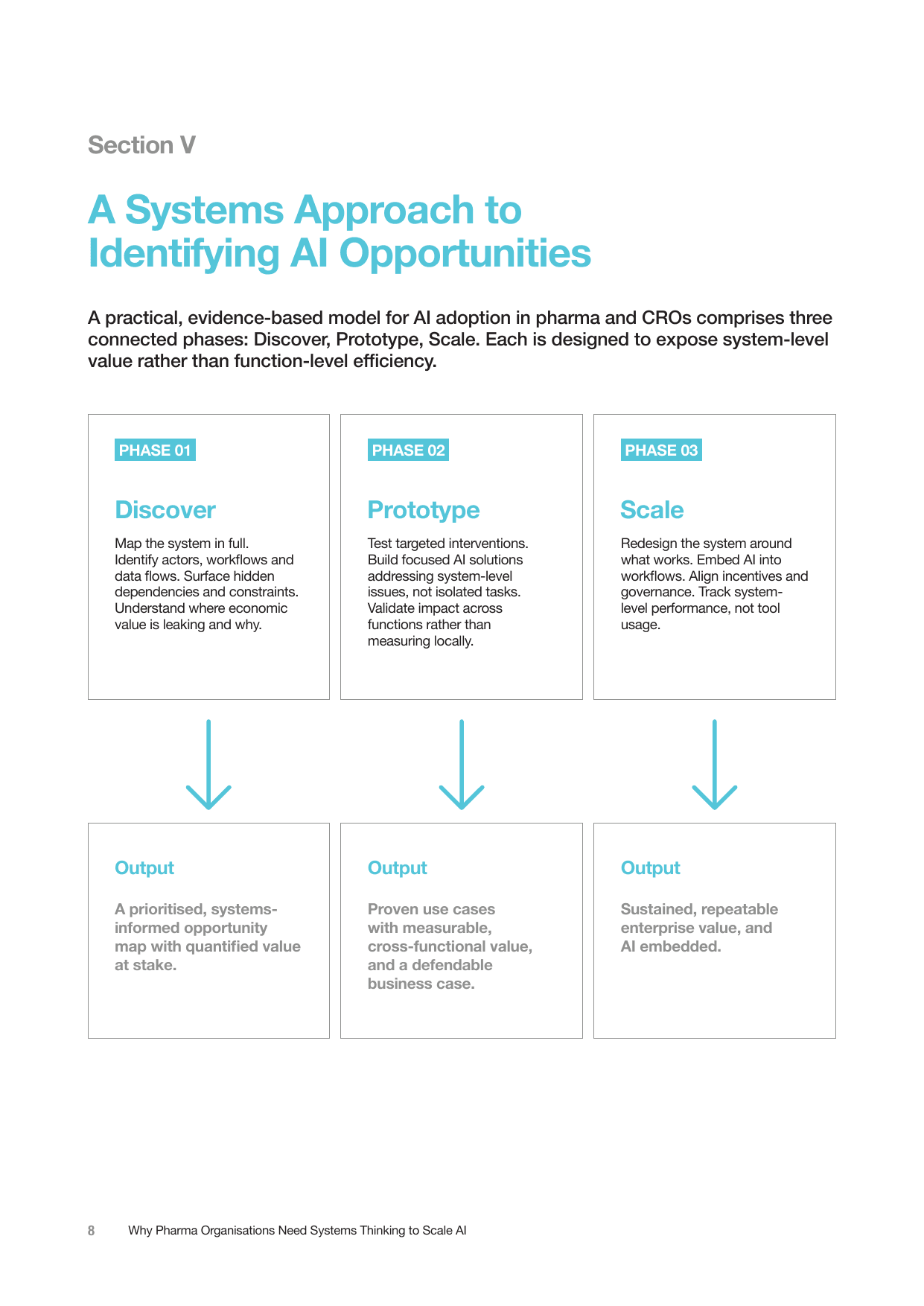
A practical, evidence-based model for AI adoption in pharma and CROs comprises three connected phases: Discover, Prototype, Scale. Each is designed to expose system-level value rather than function-level efficiency.
Phase 01: Discover. Map the system in full. Identify actors, workflows and data flows. Surface hidden dependencies and constraints. Understand where economic value is leaking and why. The output is a prioritised, systems-informed opportunity map with quantified value at stake.
Phase 02: Prototype. Test targeted interventions. Build focused AI solutions addressing system-level issues, not isolated tasks. Validate impact across functions rather than measuring locally. The output is a set of proven use cases with measurable, cross-functional value, and a defendable business case.
Phase 03: Scale. Redesign the system around what works. Embed AI into workflows. Align incentives and governance. Track system-level performance, not tool usage. The output is sustained, repeatable enterprise value, with AI embedded.
Why it matters
Redesign the system, not the task
The organisations that achieve material impact treat AI as a system intervention: they redesign information flows, decision rights, incentives and workflows across the enterprise, and measure impact at the level of the asset, the trial and the portfolio. Book a 90-minute Systems Diagnostic to map where your organisation sits and the three highest-leverage interventions in your operating model.
Book a 90-minute Systems DiagnosticVI. Case insight: CRO deal origination
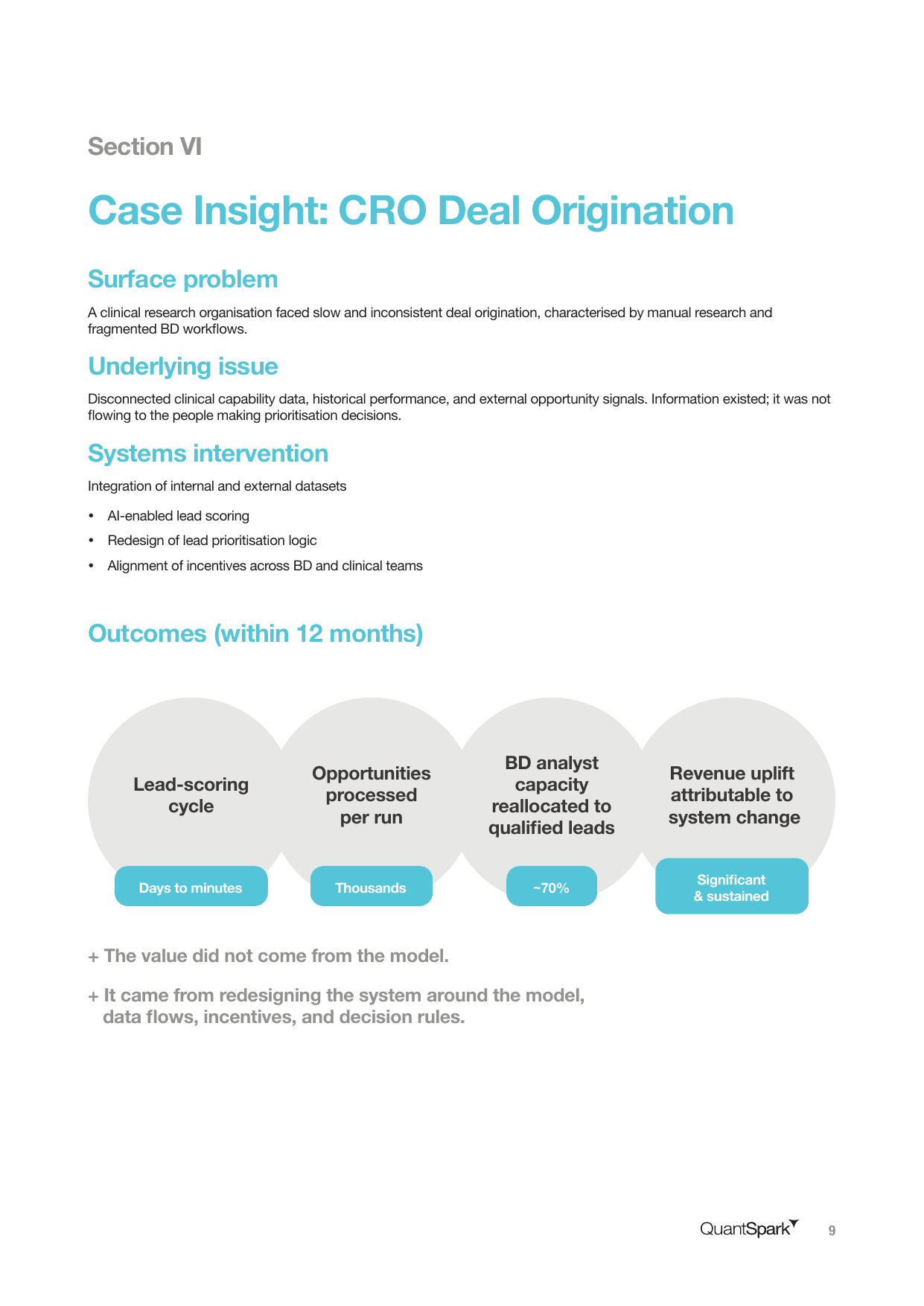
Surface problem. A clinical research organisation faced slow and inconsistent deal origination, characterised by manual research and fragmented business-development workflows.
Underlying issue. Disconnected clinical capability data, historical performance and external opportunity signals. The information existed; it was not flowing to the people making prioritisation decisions.
Systems intervention. Integration of internal and external datasets, combined with:
- AI-enabled lead scoring
- Redesign of lead prioritisation logic
- Alignment of incentives across business-development and clinical teams
Outcomes within 12 months. Lead-scoring cycle time fell from days to minutes. Thousands of opportunities were processed per run. Around 70% of business-development analyst capacity was reallocated to qualified leads. The revenue uplift attributable to the system change was significant and sustained.
The value did not come from the model. It came from redesigning the system around the model: data flows, incentives and decision rules.
The value did not come from the model. It came from redesigning the system around the model.
VII. The strategic choice: optimisation versus transformation
AI adoption is guaranteed. The choice organisations now have is whether AI is used to optimise yesterday's operating model or to build tomorrow's. The economic gap between the two is both significant and quantifiable.
Optimisation, the assumed solution, is a mindset of faster reporting, lower cost and incremental efficiency. It buys tool licences and rolls them out function by function. Its typical KPIs are hours saved, tool usage and pilot completion. Its reported impact is 5-15% function-level efficiency. It ends in strong pilots, weak portfolio impact and board scepticism.
Transformation, the actual solution, is a mindset of predictive decision-making, integrated workflows and a new operating model. It redesigns data, process, people and governance together. Its KPIs are trial duration, cost-per-patient, EBITDA margin, time-to-IND and time-to-launch. Its reported impact is a 35-45% productivity gain across clinical development, up to 12 months off trial duration and 3.4-5.4pp EBITDA expansion (McKinsey, 2025). It ends with AI embedded in operating DNA, competing on a different basis.
The choice is whether AI is used to optimise yesterday's operating model or to build tomorrow's.
VIII. Systems maturity curve
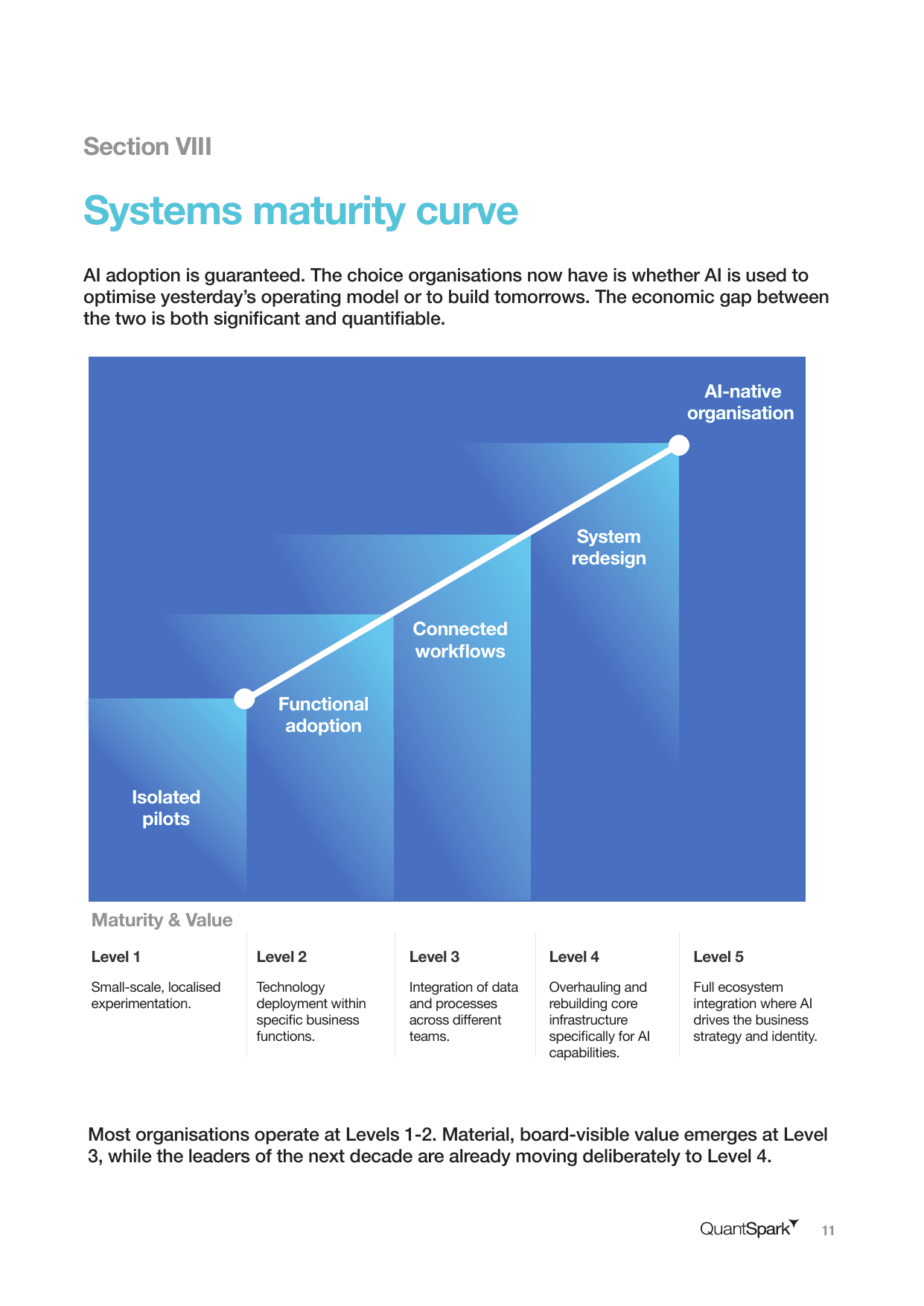
Organisations move up a five-level curve as AI shifts from isolated experiment to the basis of strategy.
- Level 1: small-scale, localised experimentation.
- Level 2: technology deployment within specific business functions.
- Level 3: integration of data and processes across different teams.
- Level 4: overhauling and rebuilding core infrastructure specifically for AI capabilities.
- Level 5: full ecosystem integration where AI drives the business strategy and identity.
Most organisations operate at Levels 1 to 2. Material, board-visible value emerges at Level 3, while the leaders of the next decade are already moving deliberately to Level 4.
Material, board-visible value emerges at Level 3.
IX. Implications for leadership
AI transformation is not a technology programme. It is an operating model shift. The pharma and CRO leaders who succeed in the next 12 to 24 months will be those who apply four principles.
Move from a parts view to a system view. Diagnose where value is lost across the whole enterprise, not within functions. The slowest step in the workflow defines the speed of the asset.
Invest in data, process and people, not just technology. Licences without redesign produce optimisation, not transformation. The 42% of pharma AI initiatives that miss ROI almost always do so for non-technical reasons.
Redesign workflows, do not automate tasks. A workflow is only as fast as its slowest step. Automating one step in a sequential process rarely changes cycle time.
Align incentives to drive adoption. An AI capability without behavioural alignment decays. If the metric is unchanged, the behaviour will be unchanged and the value will not land.
A workflow is only as fast as its slowest step.
Conclusion: AI is not scarce
Tools are no longer the differentiator. The differentiator is how an organisation is structured to extract value from AI. The evidence from pharma and CRO operations is consistent with what systems biology has taught medicine: outcomes emerge from the interaction of parts, not from the parts themselves.
Organisations that deploy AI into silos will continue to report pilot success and enterprise failure. The question facing every pharma and CRO leader is whether to build a system, or a collection of tools.
See the whole. Strengthen every part. Augment intelligently. Create lasting value.
The question facing every pharma and CRO leader is whether to build a system, or a collection of tools.
Prefer to read offline?
Download the full paper (PDF)