
Solving clearance stock build-up
A retailer was losing profit to ineffective clearance of marked-down stock. QuantSpark built a custom tool that pairs workflow automation with SKU-level predictive markdown modelling, unlocking a £3.5m annual profit uplift opportunity.
Clearance stock quietly leaks profit
Keeping unsold stock to a minimum is a core driver of retail success. Too much stock inflates production and storage costs; too little erodes customer loyalty. When markdown decisions are made without the right tools, margin leaks silently and working capital stays tied up in stock that is not selling.
The gains come from pairing workflow with prediction
The value did not sit in a single clever model. It came from combining two innovations: a workflow tool to streamline and automate clearance list execution, and a predictive model that recommends the optimal markdown strategy for each individual SKU. Together they made clearance both faster and more profitable.
Speed and accuracy compound
Executing a clearance list fell from up to 90 minutes to 5, freeing merchandisers and removing dependence on fragile Excel macro tools. Automated data cleaning diagnosed and guided resolution of data quality issues, so end users could action markdowns with full confidence in the list.
The approach ports to other retailers and categories
The tool laid the foundation for a long-term product roadmap, extending beyond clothing into further general merchandise categories. The same method can help other retailers optimise clearance operations and protect their bottom line. If clearance stock is eroding your margin, this is where the conversation starts.
Executive summary
A key factor in the success of many retailers is the ability to supply customers while keeping unsold stock to a minimum. Too much stock impacts production and storage costs; too little stock affects customer loyalty.
The Client Clearance Tool was developed by QuantSpark to solve a major business problem for a retail client: ineffective clearance of marked-down stock resulting in excess inventory.
The solution involved two key innovations:
- A workflow optimisation tool to streamline clearance list execution.
- A predictive model to recommend optimal markdown strategies at the Stock Keeping Unit (SKU) level.
The Client Clearance Tool delivered major benefits: an addressable £3.5m annual profit uplift opportunity, dramatic labour reduction through workflow improvements, and a foundation for long-term product development.
The success of the tool demonstrates the power of advanced analytics and predictive modelling to drive smarter, more profitable decisions when clearing discontinued stock. This type of solution can enable other retailers to optimise their clearance operations and increase their bottom line.
Too much stock impacts production and storage costs, too little stock affects customer loyalty.
Introduction
Retailers face constant pressure to clear stock as buying patterns shift.
At QuantSpark, we relish the opportunity to apply advanced analytics and new technology in a commercial setting, regardless of the size of the challenge.
One crucial aspect of retail management is the efficient clearance of discontinued stock, a task that until recently lacked the right tools and strategies. QuantSpark built the Client Clearance Tool to solve this.
The big idea and the business problem
During discovery we asked a straightforward question: why is there a build-up of general merchandise clearance stock in our warehouse? In response, we identified two areas of immense value where we could craft innovative solutions.
The quick win: a workflow tool. The first area involved delivering a workflow tool to enhance the execution of general merchandise clearance stock. The goal was to streamline the process, making it both more efficient and accurate by automating manual steps and reducing dependency on Excel macro tools.
The high-value solution: a predictive model. The second, more far-reaching solution was a sophisticated predictive model to generate recommendations for the optimal markdown strategy at the individual SKU level. It would guide decisions on the timing and the discounts to apply to each SKU, maximising profitability and ensuring all stock is sold within the clearance window.
Where the problem sat. Before the tool, teams struggled with a lack of suitable tools to execute clearance operations for marked-down stock, and lacked the means to leverage data-driven insights for markdown strategy. The result was a build-up of stock in stores and back-of-store warehouses through ineffective markdowns, and unrealised profit through stock not being sold.
A Pareto analysis revealed that a significant percentage of the challenges in making effective markdown decisions stemmed from a specific subset of SKUs. These fell into categories such as homeware and furniture. The analysis also highlighted that seasonal SKUs enjoyed a more straightforward process of being discontinued, exited and sold, due to the inherent nature of seasonal goods with clear clearance deadlines. Take Halloween, for example: external factors including additional marketing and seasonal demand created a sense of urgency that propelled effective clearance.
The power of predictive modelling
The Client Clearance Tool applied predictive modelling to these challenges. Historical SKU sales data played a pivotal role in crafting the optimal markdown strategy.
What did optimal mean in this context? It meant ensuring that all stock was sold within the given clearance window while retaining the maximum possible profit. This approach transformed clearance operations, making them more precise and profitable than ever before.
Optimal meant ensuring that all stock was sold within the given clearance window while retaining the maximum possible profit.
Model methodology: calculating SKU-level markdown strategies
To understand how we calculate markdown strategies at the SKU level, it is worth stepping through the model methodology. The process encompasses sales prediction, optimisation and achieving the optimal strategy.
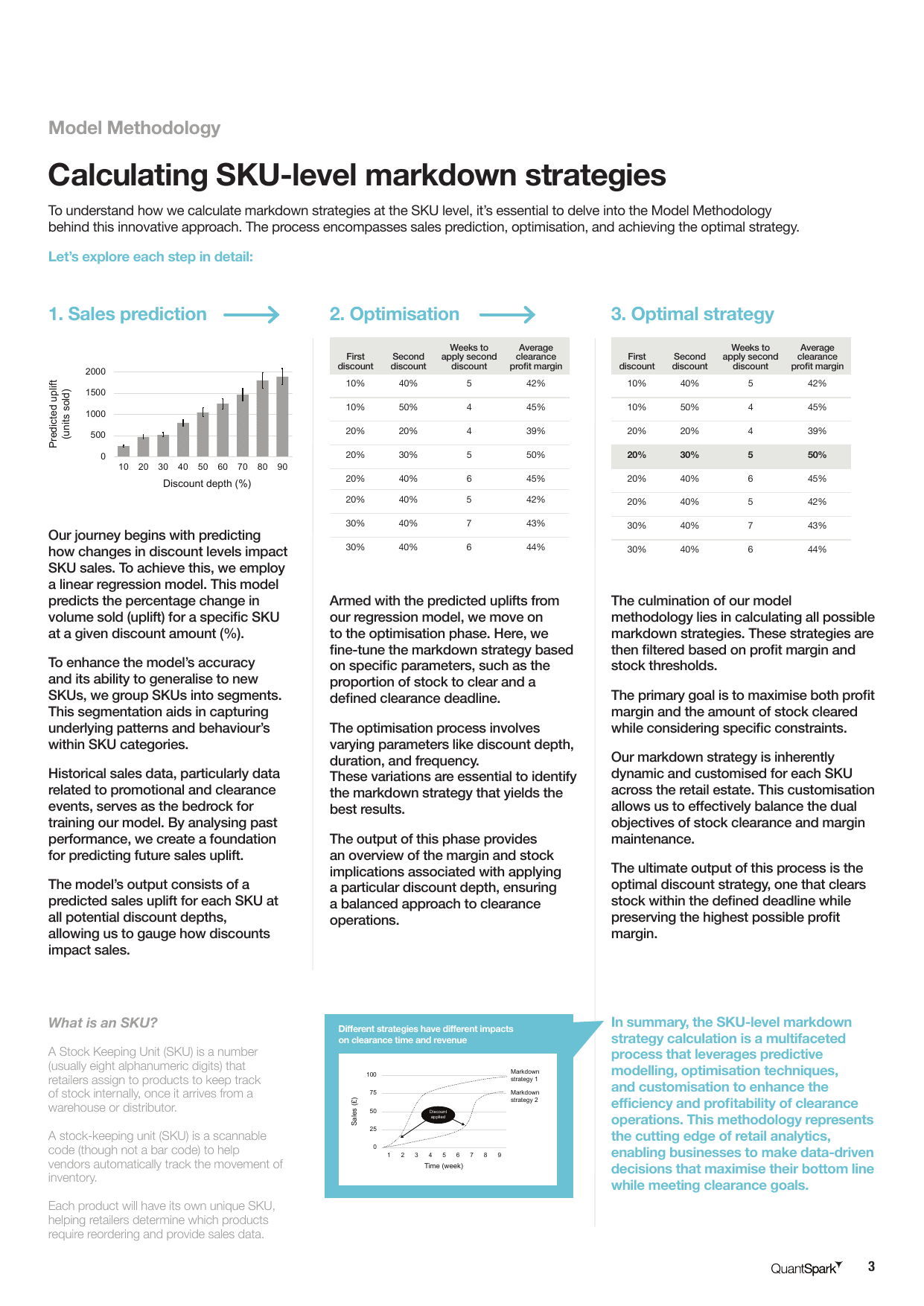
1. Sales prediction. The first step predicts how changes in discount levels affect SKU sales. To achieve this, we employ a linear regression model that predicts the percentage change in volume sold (uplift) for a specific SKU at a given discount amount. To enhance accuracy and the model's ability to generalise to new SKUs, we group SKUs into segments, capturing underlying patterns and behaviours within SKU categories. Historical sales data, particularly data related to promotional and clearance events, serves as the bedrock for training. The output is a predicted sales uplift for each SKU at all potential discount depths.
2. Optimisation. Armed with the predicted uplifts, we fine-tune the markdown strategy based on specific parameters, such as the proportion of stock to clear and a defined clearance deadline. The process involves varying parameters like discount depth, duration and frequency to identify the strategy that yields the best results. The output provides an overview of the margin and stock implications of applying a particular discount depth, ensuring a balanced approach to clearance.
3. Optimal strategy. The culmination of the methodology lies in calculating all possible markdown strategies, then filtering them on profit margin and stock thresholds. The primary goal is to maximise both profit margin and the amount of stock cleared while considering specific constraints. The markdown strategy is inherently dynamic and customised for each SKU across the retail estate, balancing the dual objectives of stock clearance and margin maintenance. The ultimate output is the optimal discount strategy, one that clears stock within the defined deadline while preserving the highest possible profit margin.
What is an SKU? A Stock Keeping Unit is a number, usually eight alphanumeric digits, that retailers assign to products to keep track of stock internally once it arrives from a warehouse or distributor. Each product has its own unique SKU, helping retailers determine which products require reordering and provide sales data.
Why it matters
The approach ports to other retailers and categories
The tool laid the foundation for a long-term product roadmap, extending beyond clothing into further general merchandise categories. The same method can help other retailers optimise clearance operations and protect their bottom line. If clearance stock is eroding your margin, this is where the conversation starts.
Talk to us about clearance and markdown optimisationBuilding the client clearance tool
Leveraging Streamlit for efficient development. One of the key factors in the tool's success was the technology stack. We selected a Python-based front-end components package called Streamlit, which significantly reduced the time required to deliver a productionised solution that end users could use. Its pre-built Python components allowed development to focus on the core model logic, accelerating time-to-market for the solution.
Workflow optimisation. The final solution was a fully productionised web application hosted on the client's AWS infrastructure, with end users logging in through their secure single sign-on credentials. The tool allowed users to drag and drop their Excel clearance list into a clean, easy-to-use interface. The application would then clean the file, diagnosing data quality issues and advising on resolution steps. Following resolution, the app generated a final clearance list, allowing end users to action the markdown with full confidence in the accuracy of the list.
Markdown strategy model. The model was delivered as a proof of concept, ready to be productionised into the Streamlit web application. It proved the efficacy of the methodology and the ability to generate recommendations across all in-scope SKUs, demonstrating the potential return on investment from making data-driven decisions for SKU-level markdown strategies.
Key innovations achieved:
- Automated data cleaning: diagnosed and guided resolution of data quality issues.
- £3.5m profit uplift opportunity: through data-driven markdown strategies.
- Sales uplift forecasting: predicted the impact of discounts on sales volume.
- Long-term product roadmap: laid the foundation for ongoing innovation.
The model proved the efficacy of the methodology and the ability to generate recommendations across all of the in-scope SKUs.
Outcomes and benefits
Faster workflow. The workflow tool significantly reduced the time it took for merchandisers to execute clearances. What used to be a cumbersome process taking up to 90 minutes per clearance list was streamlined to 5 minutes. This not only saved time but also enhanced accuracy in executing clearance operations.
Substantial profit uplift. The power of data-driven decision-making became evident as we identified a £3.5 million profit uplift opportunity annually. By leveraging historical sales data to model the optimal markdown strategy for each SKU, we enabled our client to maximise profitability while ensuring that all stock was sold within the specified clearance window.
Foundation for long-term development. Beyond its immediate benefits, the tool laid the foundations for a long-term product development roadmap and can extend to further merchandise categories beyond clothing, giving the client a base to build on.
What used to be a cumbersome process taking up to 90 minutes per clearance list was streamlined to 5 minutes.
Conclusion: how the tool can work for other retailers
The Client Clearance Tool addresses a specific retail problem: clearing general-merchandise stock efficiently. It improves markdown decisions through predictive modelling and uses data to optimise clearance operations.
As retail conditions change, tools like this help retailers clear stock faster and protect margin.
Prefer to read offline?
Download the full paper (PDF)