
Building AI into your Operating Advantage
A small group of UK firms is using AI to compress reporting cycles, cut energy spend and protect margin. The rest are still paying full price for the bottlenecks. This paper sets out where the value is, and how to capture it.
Late information is the cost driver
Most overruns and energy waste are timing failures, not skill failures. AI shrinks the gap between event and decision, surfacing slippage, defects and budget exposure days earlier. That is where the margin leaks, and where it is recovered.
The gap is widening, and it compounds
Just 1% of built-environment firms have scaled AI across projects (RICS, 2025), while BCG's 'future-built' leaders deliver 3.6x the shareholder return of peers. Every quarter of delay is ground conceded to firms whose data already feeds better decisions.
The constraint is management bandwidth, not technology
85% of AI projects fail on poor data quality and 70% of scaling challenges trace to people and process, not the model. The firms that win redesign the workflow first and choose tools second.
The next 12 to 18 months decide who leads
The firms that close the execution gap now will build a structurally different organisation, one whose returns later movers find difficult to match. The move is to diagnose the highest-pain workflows, prototype on a live project in weeks, and compound from there.
Executive summary: the case in 60 seconds
The built environment is past AI experimentation. Industry leaders such as Mace, Skanska, CBRE, JLL, British Land and Bechtel are using AI to compress reporting cycles, predict delays, cut energy spend and protect margin. The question has moved from whether you should, to where, how fast, and how to make it compound.
Value shows up in four places: productivity, predictability, energy and carbon performance, and client differentiation. Smart-building deployments report up to 155% three-year ROI and 30% lower energy spend. Generative scheduling has cut construction schedules by 40% on real megaprojects. Mace is targeting 30% productivity improvement by 2030 through digital and AI automation.
And yet the gap is widening. 45% of UK firms have no AI implementation and just 1% have scaled it across projects (RICS, 2025). BCG's 'future-built' firms deliver 3.6x the total shareholder return of peers.
Who this is for: every CEO, CFO, COO, board member and operational leader in UK development, construction, real estate, infrastructure and facilities management who has debated AI strategy without yet embedding it in the workflows that drive margin, schedule and energy performance.
The built environment is past AI experimentation.
I. The signal: from pilot to P&L
Three datasets from 2025 tell the same story. A small group of leaders is embedding AI into the workflows that drive margin and schedule. The rest are losing ground every quarter they wait.
The wider evidence. Ramp Economics Lab's 2025 analysis of 50,000+ businesses shows high AI-intensity firms achieving roughly 100% revenue growth since November 2022, against essentially zero for firms with no AI spend. McKinsey's 2025 State of AI finds 88% of large firms use AI, but only 6% are high performers. BCG's 'future-built' study finds 5% of firms create substantial value at scale, while 60% see no material gains.
The built-environment picture. RICS' 2025 survey of 2,200+ professionals globally found 45% of organisations have no AI implementation, 34% are in early pilots, and just 1% have scaled AI across projects. Yet 70% of project managers and quantity surveyors believe AI will help them deliver greater value. Investment is catching up: Q2 2025 saw $3.96bn flow into built-environment technology, with 68% of capital going to AI startups.
Five operating implications
- Late information is the cost driver. Most overruns and energy waste are timing failures. AI shrinks the gap between event and decision, surfacing slippage, defects or budget exposure days earlier.
- Data layer beats tool selection. Connected data, even imperfectly connected, beats sophisticated tools sitting on fragmented inputs. Integration is the moat.
- Redesign, don't layer. AI on legacy approval cycles produces legacy-speed results. Leaders redesign progress verification and risk escalation, and only then choose tools.
- ROI compounds across the portfolio. One project is a pilot. The same workflow run across fifty generates comparative intelligence: best trades, best assets, recurring defect patterns.
- Service and ESG move together. AI-enabled energy, water and occupancy intelligence cuts cost and strengthens the sustainability story at once. Capital partners price this in.
We find technology is not the limiting factor. In fact, management bandwidth is the binding constraint.
II. Where AI creates value right now
Value in the built environment shows up in four places, each with measured returns from real deployments.
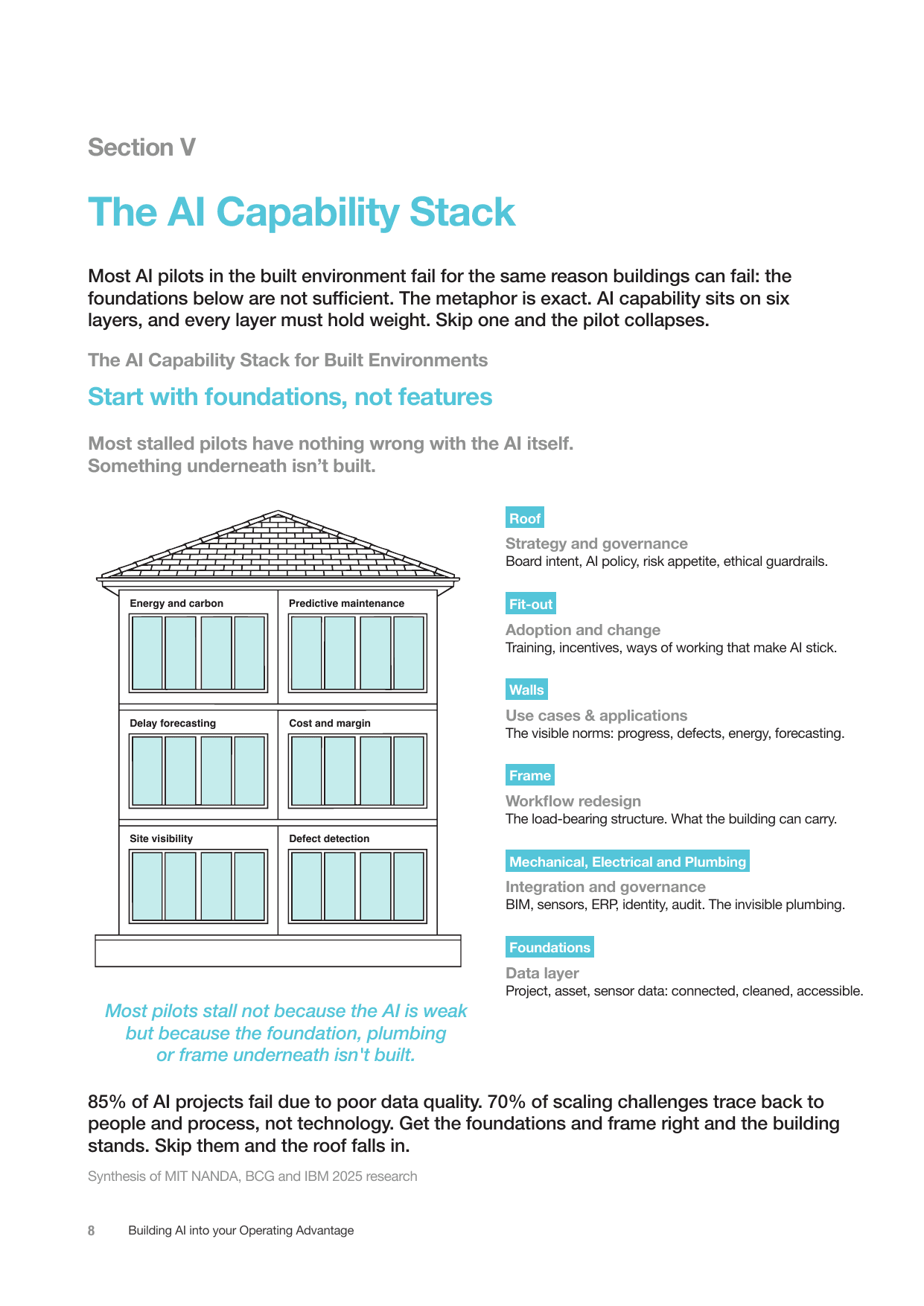
Productivity and schedule certainty. Generative scheduling, progress verification and delay prediction. McKinsey and ALICE deployments cut baseline schedules by 40% on capital projects; Suffolk Construction recovered 42 days. The potential construction productivity gain is 31% by 2030.
Energy, carbon and sustainability. Building energy optimisation, HVAC controls and occupancy. AI can cut building energy and carbon by 8 to 19% by 2050 (Nature, 2024). The Edge Amsterdam achieves 70% energy savings against typical offices, and AI estates are seeing 30% energy spend reduction.
Asset operations and maintenance. Predictive maintenance, leak detection and equipment anomaly detection across portfolios. CBRE's agentic AI facilities management reports 98% reduction in repeat alarms and 10 to 20% cleaning savings across 1bn sq ft, alongside a 25 to 30% cut in total maintenance spend.
Client, capital and service differentiation. Tenant copilots, lease analytics and ESG reporting. CBRE cut manual lease processing 25% with machine learning; 85% of institutional commercial-real-estate investors now expect AI in due diligence, and firms are seeing a 15 to 20% uplift in lead-to-lease conversion.
UK case study: Mace. Mace Construct is one of the most advanced public examples of AI scale-up in UK construction. AI and machine learning now sit at the heart of its 30% productivity target. The company is piloting 360 degree site-scanning on live projects, automating progress tracking and forecasting programme timelines so teams can intervene early on deviations. At the centre sits the Mace Data Hub: a single repository aggregating live project data, visualised through dynamic dashboards so project leaders can course-correct in real time. This is not an isolated success: SCS JV (Skanska, Costain, STRABAG) used ALICE generative scheduling on HS2's Euston cavern shaft and Copthall Green Tunnels, and Skanska UK has trialled AI to cut carbon on HS2 Main Works.
30% productivity improvement by 2030, through digital and AI automation.
III. The ROI evidence
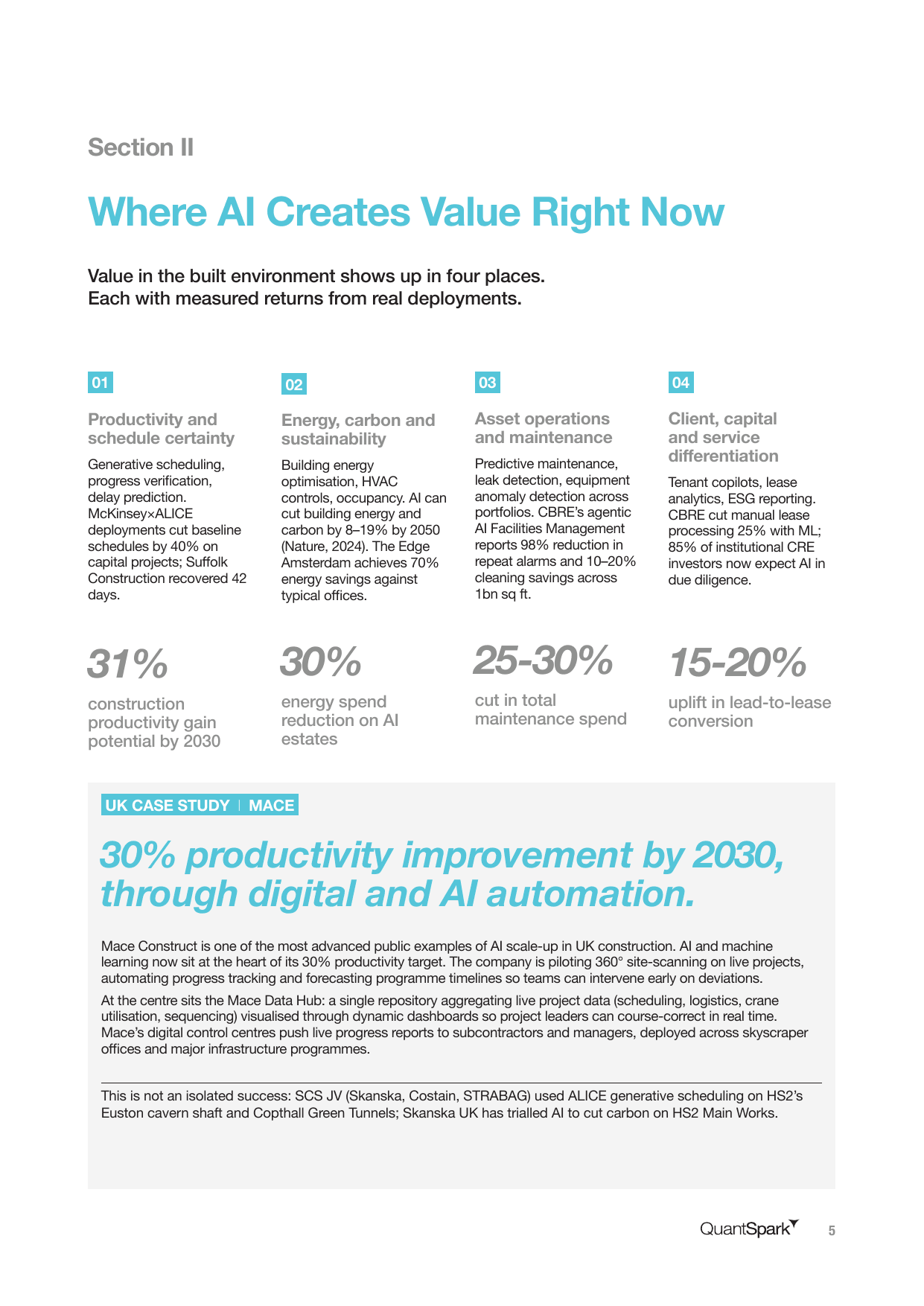
Six benchmark statistics from 2024 to 2026 deployments set the baseline for what AI returns in the built environment.
- $1.6tn is the annual construction productivity prize if the industry closes its productivity gap (McKinsey Global Institute).
- 3.6x is the total shareholder return of 'future-built' AI leaders against peers (BCG, AI at Scale, 2025).
- 40% construction schedule reduction from generative scheduling (McKinsey and ALICE Technologies).
- 30% energy spend reduction on AI estates (JLL, CBRE, Demand Logic).
- 25 to 30% cut in total maintenance spend (commercial real estate benchmarks).
- 31.7% reduction in recordable safety incidents (Golparvar-Fard et al., 28-project study).
IV. The highest-payback workflows
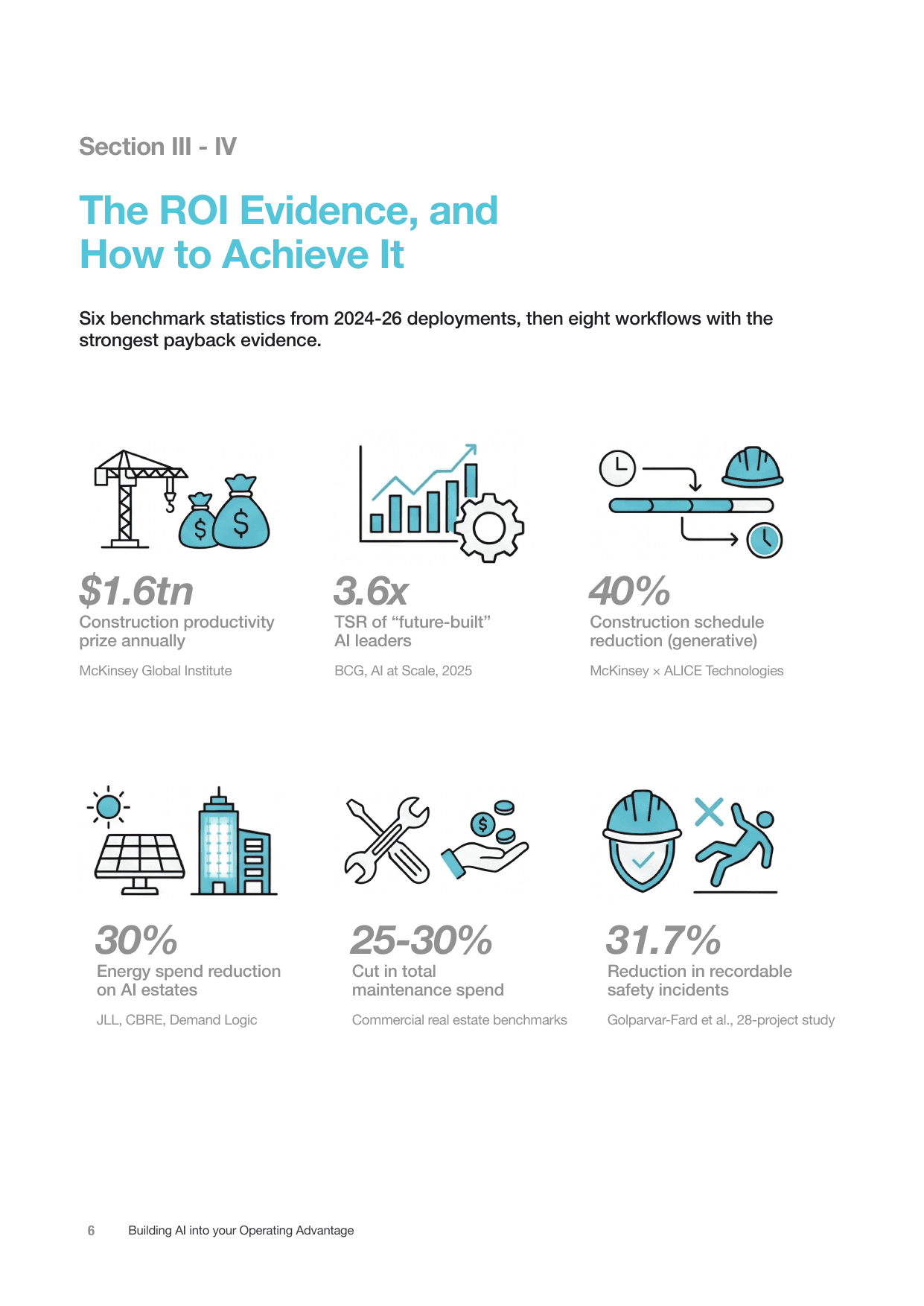
Eight workflows carry the strongest payback evidence, ordered from fastest to slowest time to value.
- Progress verification and site visibility (90 days): auto-comparison of site imagery against BIM and programme cuts manual reporting (Mace 360 degree; Suffolk, Doxel).
- Document and contract copilots (60 to 90 days): drawings, specs, lease abstraction and RFI handling. 25% lease processing cut (CBRE Ellis).
- Safety monitoring, computer vision (90 days): PPE, fall protection and danger-zone detection. 31.7% fewer incidents (Golparvar-Fard).
- Predictive maintenance and facilities management (6 to 12 months): HVAC, elevators, leak detection and vibration analytics. 25 to 30% cost cut (CBRE, JLL Prism).
- Energy optimisation and autonomous controls (6 to 12 months): HVAC orchestration, demand response and grid-aware operations. 30% energy saving (Hank; 70% at The Edge).
- Generative scheduling and delay forecasting (3 to 6 months): optioneering, sequencing and risk-driven look-ahead. 40% schedule cut (McKinsey and ALICE).
- Generative design and clash detection (6 to 12 months): optioneering, MEP routing and code compliance. 94% clash precision (XGBoost study).
- ESG, carbon and occupancy intelligence (6 to 12 months): carbon pathfinder, ScopeX and occupancy analytics. Up to 50% embodied carbon (AECOM ScopeX).
V. The AI capability stack
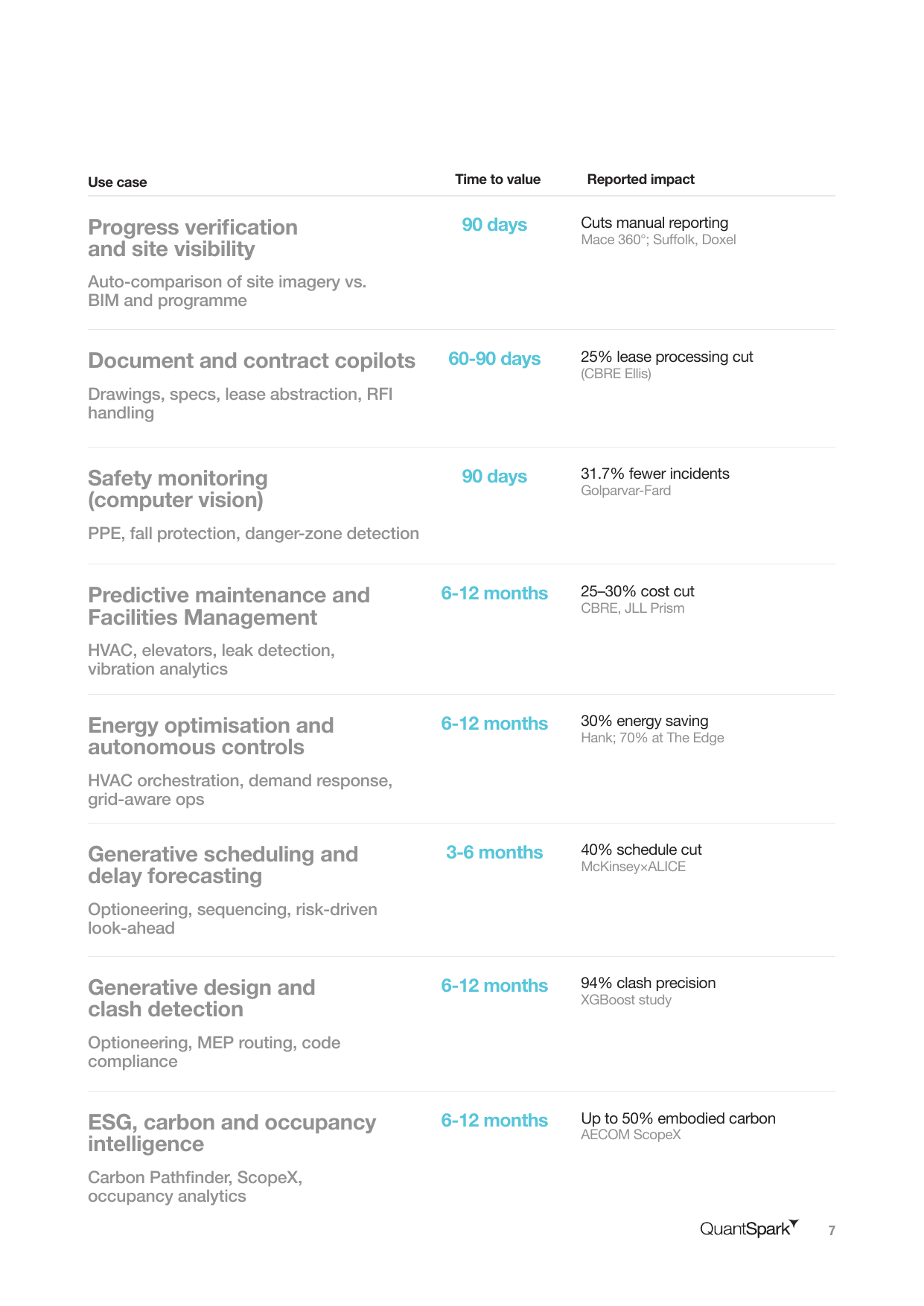
Most AI pilots in the built environment fail for the same reason buildings can fail: the foundations below are not sufficient. The metaphor is exact. AI capability sits on six layers, and every layer must hold weight. Skip one and the pilot collapses.
The six layers, foundations first
- Foundations, the data layer. Project, asset and sensor data: connected, cleaned, accessible.
- Mechanical, electrical and plumbing, integration and governance. BIM, sensors, ERP, identity and audit. The invisible plumbing.
- Frame, workflow redesign. The load-bearing structure. What the building can carry.
- Walls, use cases and applications. The visible norms: progress, defects, energy, forecasting.
- Fit-out, adoption and change. Training, incentives and ways of working that make AI stick.
- Roof, strategy and governance. Board intent, AI policy, risk appetite and ethical guardrails.
Why pilots stall. 85% of AI projects fail due to poor data quality. 70% of scaling challenges trace back to people and process, not technology. Get the foundations and frame right and the building stands. Skip them and the roof falls in. This is a synthesis of MIT NANDA, BCG and IBM 2025 research.
Most pilots stall not because the AI is weak but because the foundation, plumbing or frame underneath isn't built.
Why it matters
The next 12 to 18 months decide who leads
The firms that close the execution gap now will build a structurally different organisation, one whose returns later movers find difficult to match. The move is to diagnose the highest-pain workflows, prototype on a live project in weeks, and compound from there.
Talk to us about AI in the built environmentVI. Six questions boards must now ask
The right questions expose where a firm sits on the curve. The right framework moves it forward. Six questions boards must now ask:
- Where on the curve are we, and in which direction? If you cannot answer with project and asset data, peers who can are already ahead.
- What is our cost of information lag today? Every late reporting cycle compounds delay risk, defects and energy waste.
- Are we buying platforms, or redesigning workflows? Workflow redesign before tool selection is the largest predictor of EBIT impact (McKinsey).
- How connected is our project, asset, BIM and sensor data? Basic AI on connected data beats sophisticated AI on fragmented data. Every time.
- What is our exposure to ungoverned shadow AI? 78% of AI users bring their own tools. What client data is leaving the perimeter?
- Where will AI start to differentiate us with clients? Progress transparency, ESG and reliability are increasingly priced into deals.
Workflow redesign before tool selection is the largest predictor of EBIT impact.
VII. A framework for action
The UK Government has made an explicit, funded bet on AI as the centrepiece of economic renewal. The policy environment has never been more aligned with commercial ambition, or more demanding of operational proof. Six phases take a firm from exposure to advantage.
- Phase 01, diagnose before you deploy. Map highest-pain workflows. Pick two or three with the strongest value-to-complexity ratio.
- Phase 02, redesign, don't layer. Rebuild workflows before selecting tools. AI on a broken process produces broken outcomes faster.
- Phase 03, connect the data layer. Bring BIM, programme, commercial, asset and field data into a single decision layer.
- Phase 04, prototype in weeks. Two weeks of a working AI workflow on a real project beats six months of planning.
- Phase 05, govern, train, embed. Build governance, audit trails and professional accountability alongside training.
- Phase 06, measure and compound. Days recovered, rework avoided, energy improved. Metrics drive reinvestment.
VIII. What QuantSpark does
QuantSpark is the AI implementation partner for boards in the built environment. We work alongside developers, contractors, owners and facilities management operators in the UK to close the execution gap, turning AI from board-paper ambition into operational advantage.
We don't sell tools. We diagnose where information lag is costing margin, redesign the workflows that need to move faster, connect the data layer that makes AI work, and embed AI into the daily decisions of site managers, project directors, energy managers and facilities management leads. Four service pillars take a firm from exposure to advantage:
- Diagnose and roadmap. Map the highest-pain workflows, model the cost of information lag, and prioritise two to three use cases with the strongest value-to-complexity ratio.
- Build and integrate. Connect BIM, programme, asset and sensor data inside the client's own tenant. Sovereign deployment with Entra ID, Purview and audit trails.
- Embed and scale. Prototype in weeks on a live project. Train teams proportionately, embed AI into routine decisions, expand across the portfolio.
- Govern and measure. RICS-aligned governance, ethical guardrails, and operational KPIs (days recovered, rework avoided, energy improved) driving reinvestment.
We diagnose where information lag is costing margin, redesign the workflows that need to move faster, connect the data layer that makes AI work, and embed AI into the daily decisions.
Conclusion: the opportunity is waiting
AI in the built environment is a commercial lever, not a speculative one. The firms pulling away (Mace, Skanska, CBRE, JLL) do so through superior operational metabolism: the willingness to redesign the workflows that drive margin, schedule and energy, and the discipline to do it fast enough for compounding to take hold.
The firms that close the execution gap in the next 12 to 18 months will not simply be more efficient. They will have built a different kind of organisation. One whose project, asset and operational data feeds faster, better decisions every day, generating returns structurally difficult for later movers to match.
The opportunity is waiting. It won't wait forever.
Prefer to read offline?
Download the full paper (PDF)